
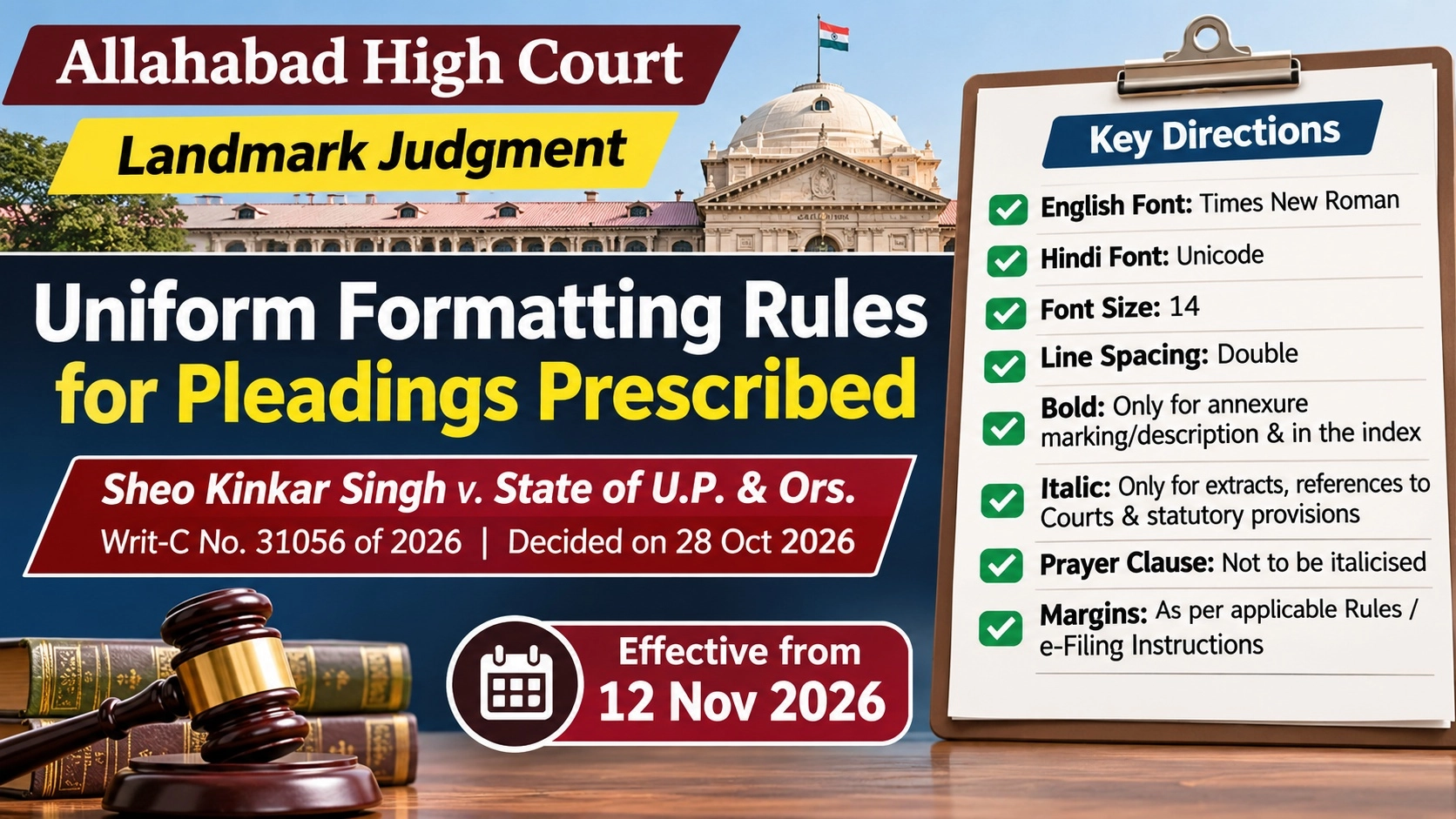
Important Judgment: Sheo Kinkar Singh v. State of U.P. and Others
Writ-C No. 31056 of 2026
Decision dated: 28 October 2026
Court: High Court of Judicature at Allahabad
Coram: Hon'ble Mr. Justice Ajit Kumar and Hon'ble Mrs. Justice Garima Prashad
1. Introduction
In an important procedural development concerning the filing and presentation of pleadings before the Allahabad High Court and its Lucknow Bench, the Division Bench of the High Court, comprising Hon'ble Mr. Justice Ajit Kumar and Hon'ble Mrs. Justice Garima Prashad, has issued comprehensive directions prescribing uniform standards for the formatting, font, font size, line spacing and use of bold and italic type in pleadings.
The judgment, delivered on 28 October 2026 in Sheo Kinkar Singh v. State of U.P. and Others, Writ-C No. 31056 of 2026, addresses a practical issue frequently encountered by advocates during the preparation and scrutiny of pleadings.
The Court noticed considerable inconsistency in the manner in which petitions and other pleadings were being presented, particularly concerning different fonts, font sizes, spacing and indiscriminate use of bold and italic lettering.
With a view to ensuring uniformity, readability and orderly presentation of judicial records, the Court has now prescribed specific formatting requirements applicable to both physical and electronic filings.
These directions shall be implemented with effect from 12 November 2026.
2. Background and Circumstances Leading to the Judgment
The controversy originated during the scrutiny of the petition filed in the present case. The Court noticed that the prayer clause of the petition had been typed in italic lettering, but the same had not been reported as a filing defect by the Stamp Reporting Section.
Upon examining the matter, the Court found that the issue was not confined to one petition. Similar inconsistencies regarding font, font size, spacing and the use of bold and italic type were appearing in several matters.
The Court accordingly called for an explanation from the officials of the Stamp Reporting Section and directed the Registrar General to place before it the relevant statutory rules, administrative instructions and directions governing:
- Font and font size in pleadings;
- Line spacing;
- Use of bold and italic lettering;
- Margins to be maintained in pleadings; and
- Formatting requirements applicable to physical and electronic filings.
The Registrar General submitted a report referring to the Allahabad High Court Rules, 1952, and the Instructions for Electronic Filing (e-Filing) applicable to the High Court.
3. Examination of the Allahabad High Court Rules, 1952
The Court examined the relevant provisions of the Allahabad High Court Rules, 1952, and noticed that the existing Rules contained certain requirements concerning margins and spacing, but did not prescribe a uniform font and font size for all pleadings.
A. Rule 2 of Chapter XIII – Double Spacing
Rule 2 of Chapter XIII of the Allahabad High Court Rules, 1952, provides that the paper-book in a First Appeal shall ordinarily be prepared with double spacing.
The Court took note of this provision while examining the existing requirements relating to the presentation of documents before the Court.
B. Rule 6 of Chapter IX – Quarter Margin
Rule 6 of Chapter IX requires every memorandum of appeal, objection or application to be fairly and legibly written, typed, lithographed or printed with a quarter margin on one side only of Government watermarked paper.
The Rule also permits the Court, where considered necessary, to allow the use of other full-scape paper or both sides of the paper.
C. Rule 11(4) of Chapter IX – Margins in Copies
Rule 11(4) further provides that copies accompanying memorandum of appeal, objections or applications shall be fairly and legibly written, typed, lithographed or printed with a quarter margin on one side of durable paper.
Thus, the Court recognised the continuing applicability of the existing margin requirements under the relevant provisions of the 1952 Rules.
4. Reference to Electronic Filing Instructions
The Registrar General also brought to the notice of the Court Clauses 2.1 and 2.2 of the Instructions for Electronic Filing (e-Filing).
Under the earlier Clause 2.1, the prescribed formatting requirements for electronic documents included:
- Paper Size: Legal (8.05" × 14")
- Top Margin: 1.5 inches
- Bottom Margin: 1 inch
- Left Margin: 1.75 inches
- Right Margin: 0.5 inch
- Alignment: Full Justification
- English Font: Arial, Size 12
- Hindi Font: Any Unicode Font, Size 14
- Line Spacing: Double
Clause 2.2 provides that documents enclosed as annexures, which are not text documents, should be scanned in black and white at 300 DPI and saved in PDF format.
The Court observed that there was no uniform prescription applicable alike to physical and electronic filings concerning font, font size, line spacing and the use of bold and italic type.
Accordingly, the Court considered it necessary to issue uniform directions governing the presentation of pleadings.
5. Mandatory Directions Issued by the High Court
The most significant part of the judgment is contained in paragraph 10, wherein the Division Bench has issued the following directions:
(i) Applicability to Physical Filings
The Court expressly directed that the newly prescribed formatting requirements shall apply equally to physical filings.
Therefore, the directions are not confined merely to e-filing or electronically prepared pleadings.
(ii) Mandatory Font and Font Size
The Court has prescribed the following requirements:
For English pleadings:
- Font: Times New Roman
- Font Size: 14
- Line Spacing: Double
For Hindi pleadings:
- Font: Unicode Font
- Font Size: 14
- Line Spacing: Double
These requirements apply to petitions, affidavits, counter-affidavits, rejoinder affidavits, replies, applications and all other pleadings prepared in the respective languages.
(iii) Restricted Use of Bold Lettering
The Court has specifically directed that bold type shall be used only for:
- Marking or description of annexures in the pleadings; and
- Marking or description of annexures in the index.
No other part of a pleading shall be set in bold type.
Consequently, advocates must avoid using bold lettering indiscriminately for headings, grounds, paragraphs, statutory provisions, arguments or prayer clauses.
(iv) Restricted Use of Italic Lettering
The Court has also restricted the use of italic type.
Italic lettering may be used only for:
- Extracts reproduced in a pleading;
- References to Courts; and
- References to statutory provisions.
The Court has specifically clarified that the prayer or relief clause shall not be italicised.
Italic lettering shall not be used elsewhere in the pleadings.
(v) Existing Margin Requirements to Continue
The Court has clarified that the requirements relating to margins under the applicable Rules and the Instructions for Electronic Filing shall continue to be observed in petitions, applications, appeals and revisions.
Thus, the newly prescribed font and formatting requirements must be followed along with the applicable existing margin requirements.
6. Effective Date and Responsibility of the Registrar General
In paragraph 11, the Court directed the Registrar General to circulate the judgment forthwith to all filing and scrutiny sections at:
- The Principal Seat of the High Court at Allahabad; and
- The Lucknow Bench of the High Court.
The Registrar General has also been directed to ensure that these requirements are brought to the notice of the Bar.
The respective Stamp Reporting Sections have been directed to scrutinise filings in accordance with the newly prescribed requirements with effect from 12 November 2026.
Accordingly, advocates and their drafting teams should ensure compliance before presenting petitions and other pleadings for filing.
7. Practical Implications for Advocates and Legal Practitioners
The judgment has considerable practical significance for the legal fraternity. It establishes a uniform drafting standard and requires advocates to reconsider certain commonly followed drafting practices.
The following precautions should be observed while preparing pleadings:
A. Font and spacing: All English pleadings should be prepared in Times New Roman, 14-point font, with double line spacing. Hindi pleadings should use a Unicode font of 14-point size with double line spacing.
B. Headings and subheadings: Advocates should avoid bold lettering for headings and subheadings. The Court has restricted bold type to the marking or description of annexures in pleadings and the index.
C. Prayer clauses: The prayer clause must be in normal type. Neither bold nor italic lettering should be used in the prayer clause.
D. Case laws and statutory provisions: Italic lettering may be used for references to Courts and statutory provisions and for extracts reproduced in pleadings, within the limits prescribed by the judgment.
E. Annexure descriptions: Bold lettering may be used for marking or describing annexures in the body of the pleading and in the index.
F. Margins: The applicable margin requirements under the 1952 Rules and e-Filing Instructions must continue to be followed.
G. Physical and electronic filing: Advocates should not assume that physical filing is exempt from these directions. The Court has expressly extended the requirements to both modes of filing.
8. Compliance Checklist for Advocates
Before filing any petition, appeal, application, revision or affidavit before the Allahabad High Court or its Lucknow Bench, the following checklist should be followed:
| ParticularsPrescribed requirement | |
| English font | Times New Roman |
| English font size | 14 |
| Hindi font | Unicode |
| Hindi font size | 14 |
| Line spacing | Double |
| Bold lettering | Only annexure marking/description in pleadings and index |
| Italic lettering | Extracts, references to Courts and statutory provisions |
| Prayer clause | Neither italic nor bold |
| Margins | As prescribed under applicable Rules/e-Filing Instructions |
| Physical filing | Directions applicable |
| Electronic filing | Directions applicable |
| Effective date | 12 November 2026 |
9. Legal Significance of the Judgment
The judgment is significant because it brings procedural uniformity to the preparation and presentation of pleadings before the Allahabad High Court and its Lucknow Bench.
Although the Allahabad High Court Rules, 1952, and the earlier e-Filing Instructions contained certain requirements concerning spacing, margins and formatting, there was no comprehensive uniform prescription governing all pleadings.
The Division Bench has now addressed this procedural gap by issuing specific directions governing font, font size, line spacing and the permissible use of bold and italic lettering.
For advocates, the judgment is not merely an administrative clarification. It lays down clear requirements that must be incorporated into the drafting and filing process.
The judgment also highlights the importance of legibility, consistency and proper presentation of pleadings as essential aspects of effective judicial administration.
10. Conclusion
The decision in Sheo Kinkar Singh v. State of U.P. and Others, Writ-C No. 31056 of 2026, dated 28 October 2026, is an important procedural ruling for every advocate practising before the Allahabad High Court and its Lucknow Bench.
With effect from 12 November 2026, English pleadings must be prepared in Times New Roman, font size 14, with double line spacing, while Hindi pleadings must be prepared in Unicode font, size 14, with double line spacing.
The use of bold and italic lettering has also been specifically restricted.
Advocates, law firms, briefing counsel, drafting clerks and legal professionals should accordingly update their standard drafting templates to ensure compliance with the directions issued by the Division Bench.
The primary takeaway is clear: Uniform formatting, proper presentation and compliance with the prescribed drafting standards are now essential requirements for filing pleadings before the Allahabad High Court and its Lucknow Bench.
Judgment referred to: Sheo Kinkar Singh v. State of U.P. and Others, Writ-C No. 31056 of 2026, decided on 28.10.2026, High Court of Judicature at Allahabad, Hon'ble Ajit Kumar, J. and Hon'ble Garima Prashad, J.
Relevant paragraphs: Paragraphs 2–11, particularly paragraphs 10 and 11.
Important legal observation: The judgment does not expressly amend the Allahabad High Court Rules, 1952. It issues specific judicial directions governing the presentation and scrutiny of pleadings. Therefore, the article appropriately describes these requirements as directions of the Division Bench rather than a formal amendment to the Rules.
The most important operational date for advocates is 12 November 2026.
linke of Judgment
https://elegalix.allahabadhighcourt.in/elegalix/WebDownloadJudgmentDocument.do?judgmentID=13859683
https://t.me/sajjadhusainlaw/388
Sajjad Husain Advocate, Advocate Chamber No. 515 Block C High Court Lucknow UP India PIN 226010 WhatsApp & Calling No. 7080909786
No comments yet. Be the first to share your thoughts!