
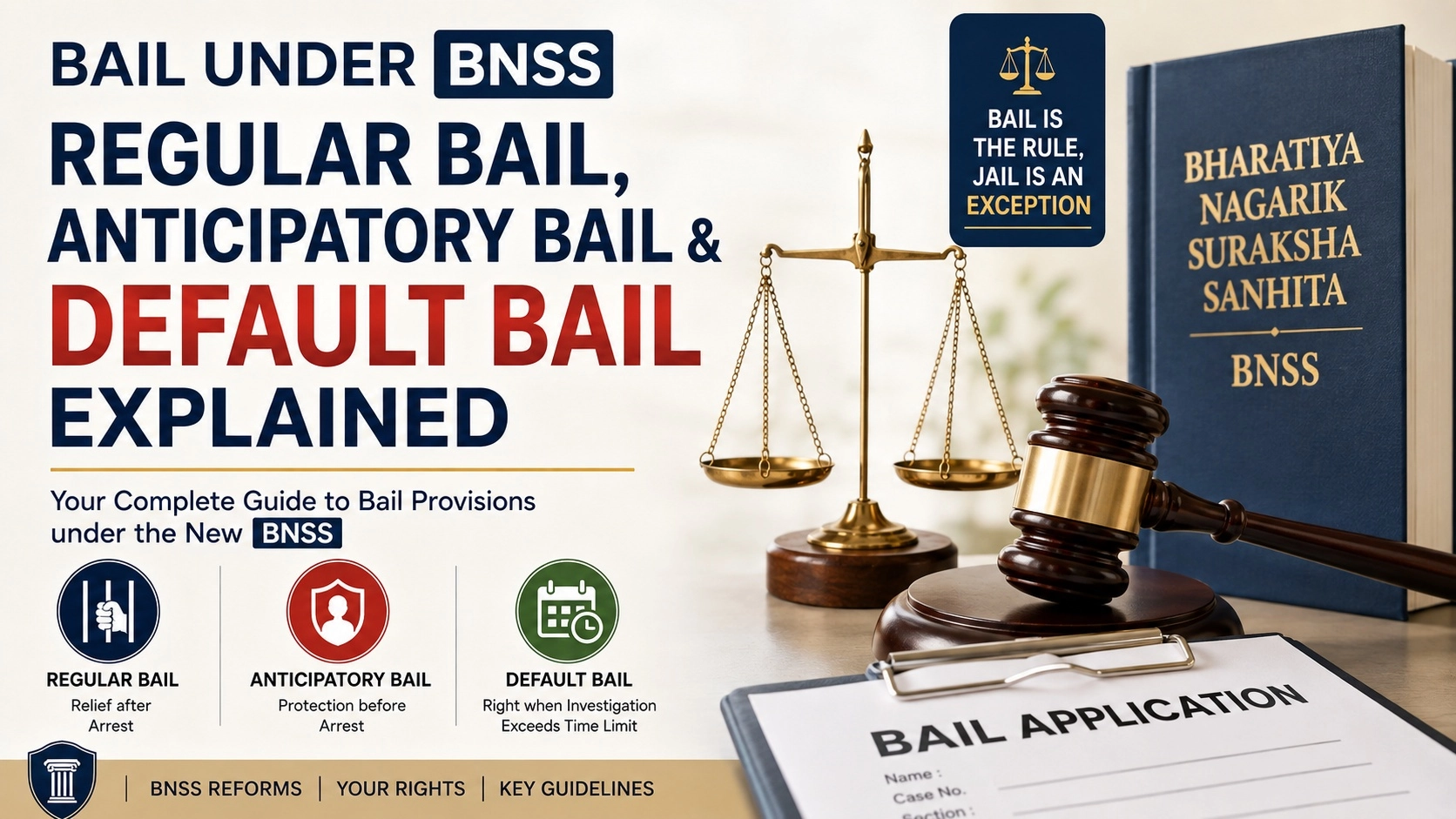
Bail under BNSS: Regular Bail, Anticipatory Bail & Default Bail Explained
TL;DR: "Bail is the rule, jail is an exception" remains the bedrock of Indian criminal jurisprudence. Under the new Bharatiya Nagarik Suraksha Sanhita (BNSS), while the fundamental types of bail (Regular, Anticipatory, and Default) remain intact, the procedural timelines and conditions for the release of undertrial prisoners have undergone significant updates to address the chronic issue of overcrowded prisons.
For centuries, the power to arrest and the subsequent right to bail have represented the ultimate tension in criminal law: balancing the state's duty to investigate crime against an individual's fundamental right to liberty. When a person is accused of a crime, they are presumed innocent until proven guilty. Therefore, keeping an accused incarcerated during a prolonged investigation or trial is considered a severe deprivation of personal liberty. The Bharatiya Nagarik Suraksha Sanhita (BNSS), which replaces the 1973 Code of Criminal Procedure (CrPC), modernizes the bail framework.
Understanding the nuances of bail under the BNSS is critical for legal practitioners and the general public alike. This guide breaks down the three primary categories of bail and the landmark judicial principles that govern them.
The Framework of Regular Bail
Regular bail is the most common form of relief sought by an individual who has already been arrested and is currently in police or judicial custody. When an accused is in jail, their lawyer approaches the Magistrate or the Sessions Court to seek their release on bail pending the conclusion of the trial.
The approach to regular bail depends entirely on the nature of the offense, which is categorized into two buckets:
- Bailable Offenses: For less serious crimes (e.g., simple hurt, defamation), bail is a matter of absolute right. Under the BNSS, if the accused is prepared to give bail, the police officer or the court is legally bound to release them. The court has no discretion to refuse bail here.
- Non-Bailable Offenses: For grave crimes (e.g., murder, rape, serious fraud), bail is not a right but a matter of judicial discretion. The court evaluates several factors before granting regular bail in these cases.
When deciding whether to grant regular bail for a non-bailable offense, courts do not conduct a mini-trial. Instead, they look at specific parameters established by decades of Supreme Court jurisprudence. These include the nature and gravity of the accusation, the severity of the potential punishment, the danger of the accused absconding or fleeing justice, the character and standing of the accused, and the likelihood of the offense being repeated.
Anticipatory Bail: Protection Before Arrest
Anticipatory bail is exactly what it sounds like: it is bail granted in anticipation of an arrest. It is a preemptive strike to protect an individual's liberty when they have a reasonable apprehension that they might be arrested on false or frivolous charges involving a non-bailable offense. This provision is vital in preventing politically motivated arrests, corporate rivalries, or personal vendettas from weaponizing the police machinery.
Unlike regular bail, which can be granted by a Magistrate, an application for anticipatory bail can only be moved before the Court of Session or the High Court. If the court grants anticipatory bail, it issues a direction that in the event of an arrest, the person shall immediately be released on bail.
The Supreme Court, in the historic constitution bench judgment of Gurbaksh Singh Sibbia v. State of Punjab (1980), laid down the definitive guidelines for anticipatory bail. The court emphasized that a person's liberty should not be compromised based on mere allegations. Later, in Sushila Aggarwal v. State (NCT of Delhi) (2020), the Supreme Court clarified that anticipatory bail does not have an automatic "expiry date" and can continue until the end of the trial, unless specifically limited by the court.
Default Bail: The Statutory Right to Liberty
Default bail, also known as statutory bail, is one of the most powerful mechanisms to protect an accused from endless police investigations. Under criminal law, the police do not have an infinite amount of time to investigate a case while the accused sits in jail.
The BNSS (Section 187, continuing the CrPC framework) mandates strict timelines for the police to complete their investigation and file the final report (charge sheet). Depending on the severity of the offense, this timeline is either 60 days or 90 days. For serious offenses punishable with death, life imprisonment, or imprisonment for a term of not less than 10 years, the police have 90 days. For all other offenses, they have 60 days.
Once the statutory period expires without a charge sheet being filed, the accused acquires an indefeasible right to default bail if they apply and are prepared to furnish bail. The Supreme Court has repeatedly held that this right is a fundamental part of the right to life and personal liberty under Article 21 of the Constitution.
The Satender Kumar Antil Guidelines
No discussion on modern bail jurisprudence is complete without acknowledging the monumental Supreme Court judgment in Satender Kumar Antil v. Central Bureau of Investigation (2022). The court heavily emphasized that unnecessary arrests should be avoided, categorizing offenses into distinct buckets to streamline bail applications. It strengthened the principle that bail is tied to fundamental liberty, issuing binding guidelines for trial courts and high courts to ensure bail applications are disposed of rapidly, a principle that continues to resonate powerfully within the BNSS reforms.
Core Insights and Final Thoughts
The evolution of bail jurisprudence in India demonstrates a continuous struggle to check arbitrary state power. The transition to the BNSS brings notable administrative tweaks—including greater use of electronic communication and technology in court proceedings. However, the core principles remain the same.
For individuals facing the criminal justice system, understanding that bail for non-bailable offenses requires demonstrating to the court that you are not a flight risk and will not tamper with evidence is crucial. Anticipatory bail remains the best defense against malicious prosecution, while default bail serves as the ultimate check on sluggish police investigations. As the BNSS provisions are tested in High Courts across the country, the judiciary will once again be tasked with ensuring that procedure does not eclipse the fundamental right to liberty. After all, the deprivation of liberty before a conviction is a necessary evil of the justice system, but it must never be used as a pre-trial punishment.
No comments yet. Be the first to share your thoughts!