
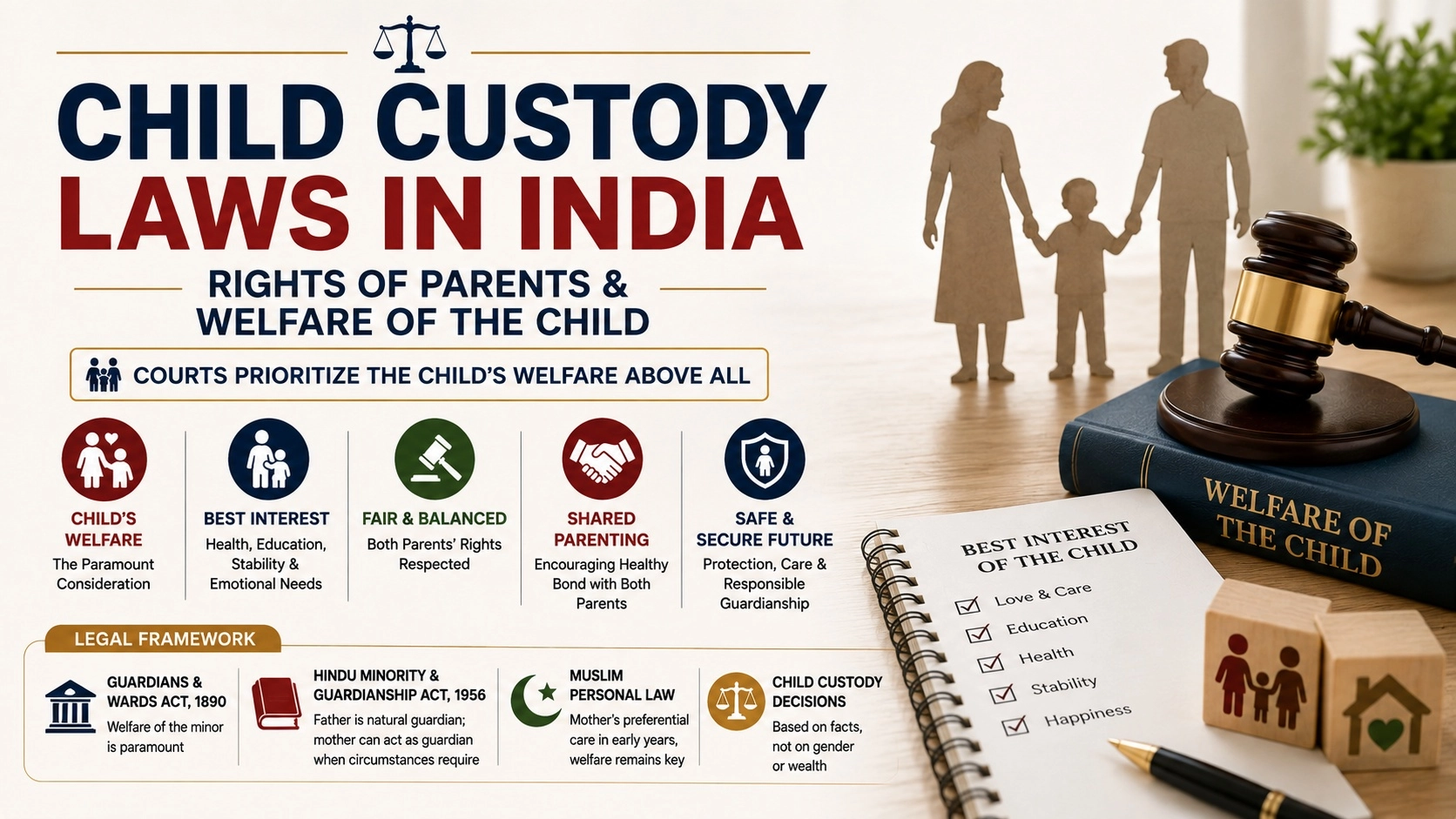
Child Custody Laws in India: Rights of Parents & Welfare of the Child
When a marriage dissolves, assets can be divided, bank accounts can be split, and properties can be sold. Unlike property disputes, child custody decisions are not about ownership or division. Courts focus on creating arrangements that protect the child's welfare and relationship with both parents. The battle for child custody is undoubtedly the most emotionally agonizing, high-stakes phase of any matrimonial dispute.
The Indian legal system operates on a fundamental paradigm shift when dealing with children. The courts do not view a child as a "property" to be awarded to the winning parent. Instead, family law operates on one supreme, uncompromising principle: The Paramount Welfare of the Child. Regardless of the parents' legal rights, egos, or financial status, the court will place the physical, emotional, and psychological well-being of the child above all else.
If you are navigating a separation, understanding how Indian courts interpret guardianship, the factors that influence custody, and the different types of custody arrangements is critical to protecting your relationship with your child.
The Legal Framework: Guardianship vs. Custody
Before diving into court considerations, it is important to understand the legal distinction between a guardian and a custodian, as well as the statutes governing them depending on your religion.
- Guardianship refers to the legal authority and responsibility to make important decisions concerning the child's welfare, education, health, and property where applicable.
- Custody refers to the physical care and daily control of the child. A parent may have physical custody while both parents share joint legal guardianship.
In India, child custody is primarily governed by secular laws and personal laws:
What Factors Do Courts Consider for Custody?
Because the "welfare of the child" is an abstract concept, family court judges rely on a combination of specific factors to determine which parent can provide a healthier environment. The court essentially conducts a comparative analysis of both parents.
| Factor | How the Court Interprets It |
|---|---|
| Age, Sex, and Emotional Needs | Courts heavily lean towards giving physical custody of infants and toddlers (under 5 years) to the mother. For older children, courts may consider the child's age, gender, emotional needs, and existing relationship with each parent, but no automatic preference exists solely based on the child's sex. |
| Wishes of the Child | If the child is mature enough to express an independent opinion, courts may consider the child's wishes. There is no fixed age threshold; maturity and understanding are more important than age alone. |
| School Continuity & Stability | Courts examine the existing caregiving arrangement and prioritize the stability of residence so the child's education and familiar environment are not unnecessarily uprooted. |
| Financial Stability vs. Emotional Care | A wealthy father cannot claim custody merely because the mother earns less. If the mother provides better emotional care, the court will grant her custody and order the financially stronger parent to contribute toward the child's maintenance, education, healthcare, and other needs. |
| Safety and Moral Character | History of domestic violence, substance abuse, severe mental illness, or criminal behavior are major red flags. Such factors can strongly influence custody decisions if they affect the child's safety, emotional well-being, or development. The parent's willingness to support the child's relationship with the other parent is also heavily weighed. |
Types of Child Custody in Indian Courts
Custody isn't always a winner-takes-all scenario. Indian courts utilize several distinct custody categories depending on the stage of the litigation and the family's dynamics.
1. Physical Custody: This refers to where the child physically resides. One parent (usually the primary caregiver) gets physical custody, while the other is granted visitation/access rights.
2. Legal Custody: This refers to the right to make major life decisions (education, religion, medical) for the child. It is common for courts to grant sole physical custody to one parent while retaining joint legal custody for both, meaning they must consult each other.
3. Interim Custody: Because matrimonial disputes can take years to resolve, courts frequently issue interim custody orders to establish a temporary living arrangement and visitation schedule for the child while the main divorce case is pending.
4. Joint / Shared Parenting: Courts are increasingly recognizing the importance of meaningful involvement of both parents, though joint physical custody arrangements remain less common compared with primary custody arrangements with visitation rights. Shared parenting arrangements may involve structured schedules depending on the child's age, schooling, location, and the ability of parents to cooperate.
5. Third-Party Custody: In exceptional circumstances, courts may place a child under the care of a suitable third party such as grandparents or relatives when it serves the child's welfare and both biological parents are deemed unfit.
Busting Common Custody Myths
Because family law is deeply intertwined with societal norms, several misconceptions exist:
- Myth: The mother always wins custody.
- While mothers have a natural advantage with young children, courts will not hesitate to grant custody to fathers if the mother is proven unfit or if older children express a strong, rational preference to live with their father.
- Myth: An adulterous spouse loses child custody.
- Adultery is a valid ground for divorce, but being a "bad spouse" does not automatically mean being a "bad parent." The court will evaluate whether the parent's moral conduct directly harms the child before altering custody.
- Myth: I don't earn, so I will lose my child.
- False. Earning capacity is not the sole criteria. Courts may order the financially stronger parent to contribute toward the child's maintenance while granting custody to the non-earning primary caregiver.
Final Thoughts
The fight for child custody is grueling. Courts are increasingly concerned about parental alienation, where one parent attempts to damage the child's relationship with the other parent. Judges look highly unfavorably upon parents who use their children as pawns to exact revenge on their ex-spouses.
If you are approaching a custody battle, the best legal strategy is to genuinely prioritize the child's routine, emotional peace, and developmental needs. Litigation should always be the absolute last resort, as the courtroom environment is rarely conducive to the healthy psychological development of a child.
No comments yet. Be the first to share your thoughts!