
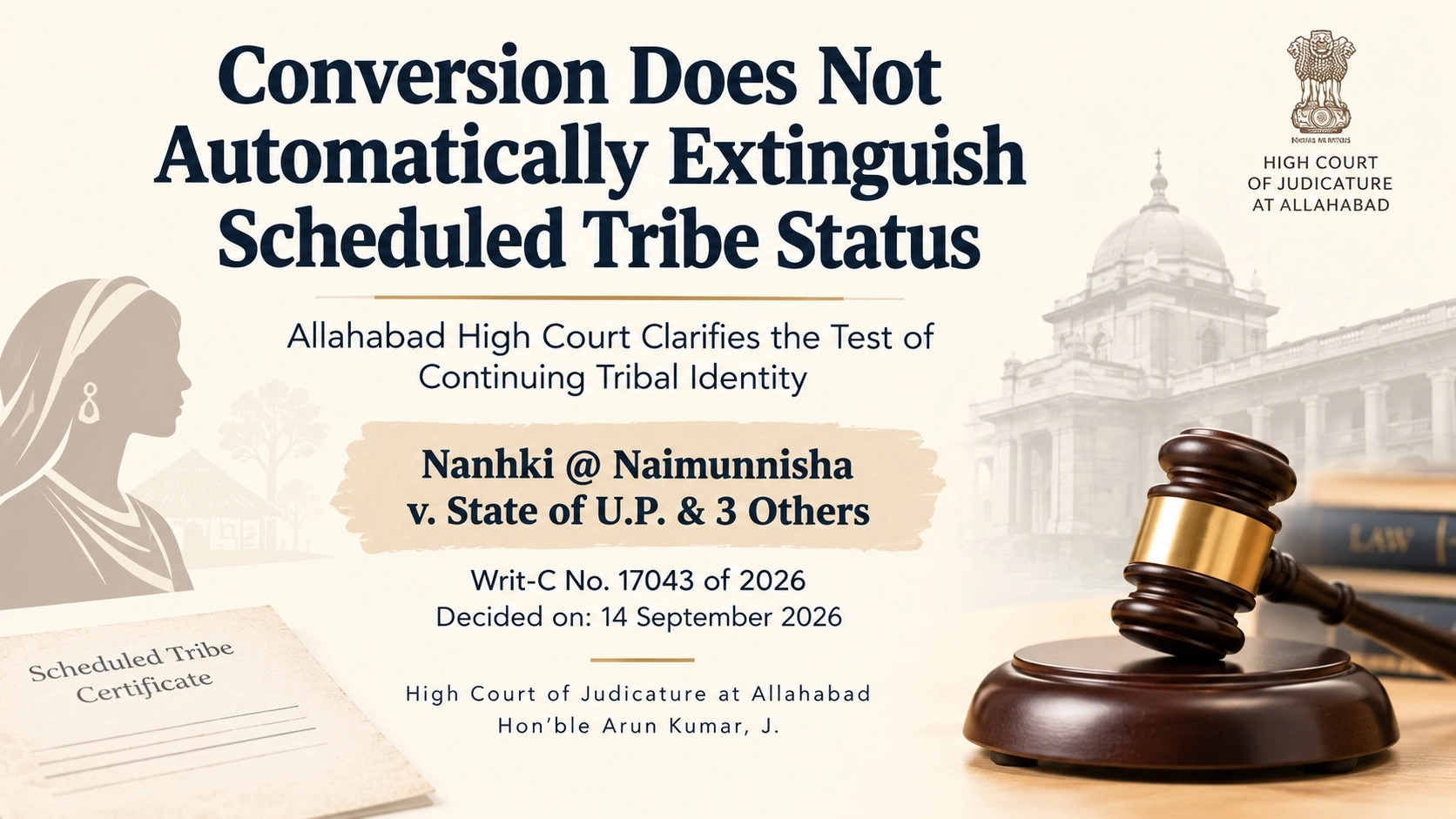
The Allahabad High Court has recently examined an important question In Nanhki @ Naimunnisha v. State of U.P. & 3 Others, the Court considered whether a woman who claimed to have been born into the Bhuiyan Scheduled Tribe could continue to claim the statutory protection available to a member of a Scheduled Tribe after marrying a Muslim man, adopting the name Naimunnisha and living for several decades within a different religious and social setting.
The judgment makes an important distinction: mere conversion to another religion does not, by itself, automatically extinguish Scheduled Tribe status. However, the continuance of that status is ultimately a question of fact, requiring examination of tribal traits, customs, traditions, community life and recognition by the concerned tribal community.
The Court ultimately dismissed the writ petitions because the petitioner failed to establish, on the facts before the Court, that she continued to possess the necessary tribal identity and community affiliation on the dates on which the disputed land transactions were executed.
The facts of the case are that the petitioner, Nanhki @ Naimunnisha, resident of Village Korchi, Pargana and Tehsil Duddhi, District Sonbhadra, claims to belong to the Bhuiyan Scheduled Tribe by birth. She claims to be the daughter of Mahaveer, who belonged to the Bhuiyan community, and relies upon a Scheduled Tribe certificate issued in her favour by the Tehsildar, Duddhi. Thereafter, she purchased the agricultural lands in dispute, situated at Village Bagharu, Pargana and Tehsil Duddhi, District Sonbhadra, by means of registered sale deeds. According to the petitioner, her Vendors belonged to the Gour Scheduled Tribe and, consequently, the transaction was between two persons belonging to the Scheduled Tribe. The petitioner asserts that the caste status of the parties was disclosed in the sale deeds itself and that she has remained in physical possession of the property ever since the transaction.
The Deputy Collector, Duddhi, District Sonbhadra orders dated 22.01.2026, held the sale deeds, being in contravention of the provisions of section 99 of the Uttar Pradesh Revenue Code/ Section 157-B, of the U. P. Zamindari Abolition and Land Reforms Act, 1950, is void, and directed that the disputed land be dealt with in accordance with the statutory consequences, including vesting in the State Government.
For context, Section 157-B of the U.P. Zamindari Abolition and Land Reforms Act, 1950 and Section 99 of the 2006 UP Revene Code restrict the transfer of land belonging to a Scheduled Tribe to a person who is not a member of a Scheduled Tribe.
Aggrieved by the orders, the petitioner has approached High Court under Article 226 of the Constitution seeking quashing of the said orders and protection of her possession over the property.
The Core Legal Issue- The central issue before the Court was not simply whether the petitioner had converted to Islam.
The real question was:
Whether the petitioner continued to possess the status of a member of the Bhuiyan Scheduled Tribe on the respective dates on which the disputed sale deeds were executed.
Hon'ble High Court Relying upon judgment of the Supreme Court in State of Kerala v. Chandramohanan, 2004(3) SCC 429, & Chinthada Anand v. State of A.P., 2026 SCC OnLine SC 466 the Court observed that there can be no broad proposition that a person ceases to be a member of a Scheduled Tribe merely because of a change of religion. Instead, the question has to be determined by examining factual circumstances, including: tribal traits, customs, traditions, continuing connection with the tribal community, customary practices, community life, and acceptance by the concerned tribal community.
Thus, the judgment rejects an automatic religion-based exclusion from Scheduled Tribe status.
The Court observed that Section 157-B of the U.P. Zamindari Abolition and Land Reforms Act, 1950 imposed a statutory restriction upon transfer by a bhumidhar or asami belonging to a Scheduled Tribe in favour of a person who did not belong to a Scheduled Tribe.Consequently, if the petitioner did not possess the requisite Scheduled Tribe status on the date of transfer in her favour, it was prohibited notwithstanding the registration of the sale deed. Registration, payment of consideration or mutation in the revenue records, according to the respondents, cannot validate a transaction which the statute itself prohibits. The Court relied upon the judgment of the Supreme Court in Additional Commissioner, Revenue v. Akhlaq Hussain and another, 2020 (4) SCC 507.
Final Holding: Ultimately, the Court concluded that the petitioner had failed to establish that she continued to possess Bhuiyan Scheduled Tribe status on the respective dates of execution of the disputed sale deeds.
The Court was careful to state that its conclusion was not based merely on marriage, merely on alleged conversion, or merely on the entry describing the petitioner as Muslim.
Rather, it was based upon the prolonged circumstances relating to her family, religious and social identity, together with the absence of convincing material establishing continued adherence to Bhuiyan customs, continued participation in community life and acceptance by the Bhuiyan community.
Consequently, the Court held that the statutory basis of the petitioner's acquisition failed and that the transactions were hit by the statutory prohibition. The writ petitions were dismissed, the orders dated 22 January 2026 were affirmed, and any interim order operating in favour of the petitioner was vacated.
Conclusion
On one hand, the Court does not accept the proposition that conversion automatically terminates Scheduled Tribe status. On the other hand, it also does not accept that a person’s original tribal status can never be examined after a prolonged change in religious and social identity.
The judgment therefore establishes a nuanced legal position: conversion is not, by itself, sufficient to extinguish Scheduled Tribe status; however, where the evidence cumulatively demonstrates severance from tribal customs, social practices and community life, the continued statutory status may be questioned and must be established on the relevant date.
For land transactions involving Scheduled Tribes, the decision further reinforces that statutory restrictions prevail over registration, mutation, possession and passage of time. A transaction prohibited by law cannot acquire validity merely because it has been registered or acted upon for several years.
Key Legal Principles Emerging from the Judgment
1. Conversion is not an automatic disqualification
2. Continuing tribal identity is a question of fact
3. Birth status is relevant but not necessarily conclusive
4. Scheduled Tribe certificate is important evidence, but not an absolute bar to further inquiry.
5. Registration cannot validate an illegal transaction.
6. Mutation and possession do not cure illegality.
7. Delay does not necessarily validate a void transaction.
8. The applicable law is the law governing the transaction.
Case: Nanhki @ Naimunnisha v. State of U.P. & 3 Others
judge: Hon'ble Arun Kumar, J.
No comments yet. Be the first to share your thoughts!