
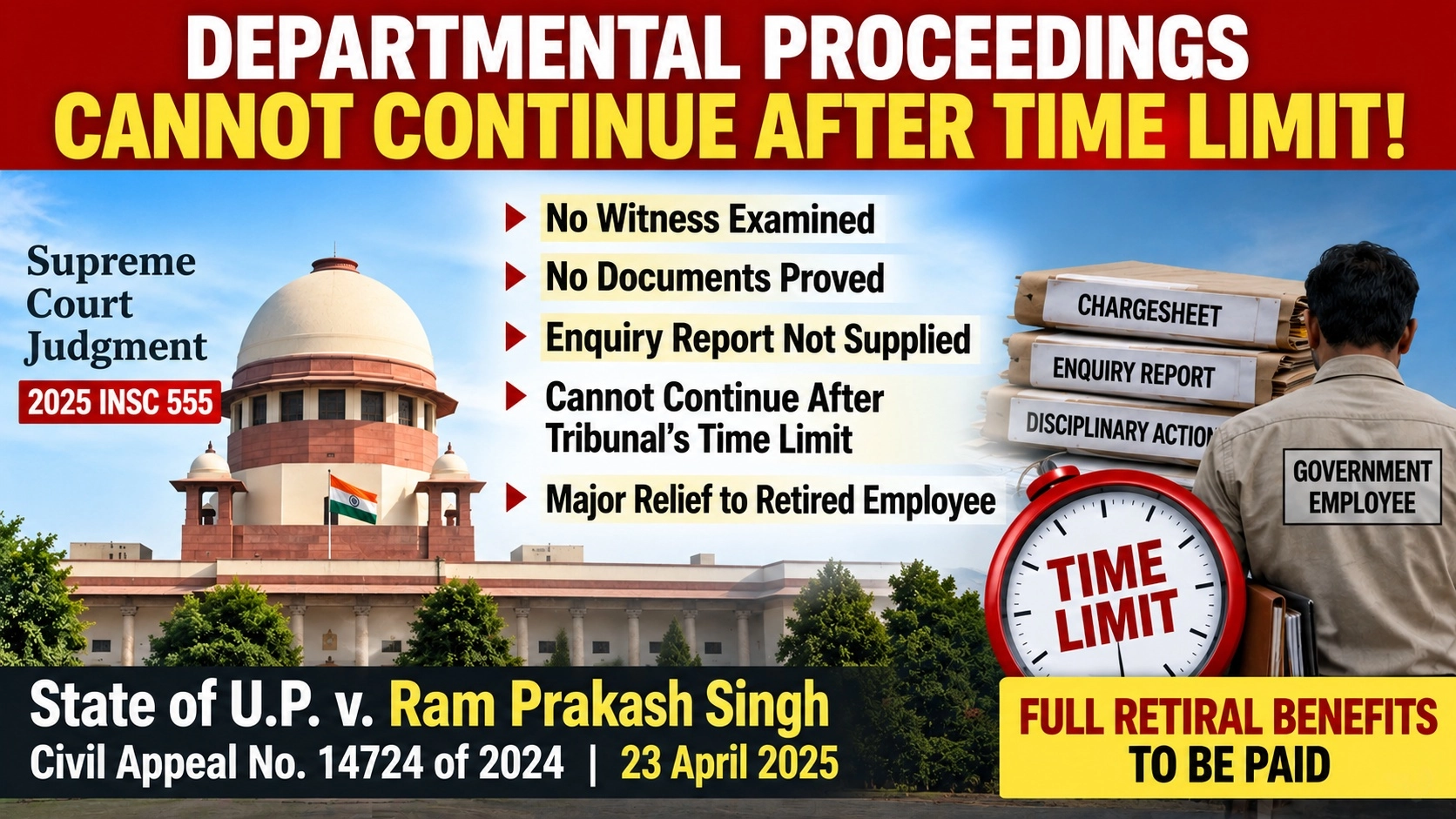
State of Uttar Pradesh v. Ram Prakash Singh
Civil Appeal No. 14724 of 2024
2025 INSC 555 | 23 April 2025
Supreme Court of India — Hon'ble Justice Dipankar Datta & Hon'ble Justice Prashant Kumar Mishra, JJ.
This judgment is an important decision on departmental enquiries, natural justice, supply of the enquiry report, proof of documents, and time limits fixed by a Tribunal/Court.
1. Facts of the Case
Ram Prakash Singh was working as an Assistant Engineer in the District Panchayat, Kushinagar. The State alleged that he was involved in embezzlement of Panchayat funds relating to road and drainage works.
A preliminary enquiry was conducted and audit reports alleged financial loss to the Government. A chargesheet containing five charges was subsequently issued against him.
However, during the departmental enquiry:
- No witness was examined to prove the charges.
- The documents relied upon by the department were not properly proved.
- Documents relied upon in the enquiry were not supplied to the employee.
- The Enquiry Officer relied substantially on the chargesheet, the employee's reply and preliminary-enquiry material.
- The enquiry report was also not furnished to Ram Prakash Singh before punishment was imposed.
2. First Round of Litigation
The Tribunal found that the enquiry had not been conducted in accordance with Rule 7 of the U.P. Government Servants (Discipline and Appeal) Rules, 1999.
The Tribunal directed the State to conduct the enquiry properly and specifically gave a three-month period for completion of the enquiry. That period expired in April/May 2014, but the State did not obtain an extension from the Tribunal.
Despite expiry of the prescribed period, the Enquiry Officer continued the proceedings and submitted another report on 15 September 2014, again holding the employee guilty without examining witnesses.
The State thereafter imposed a fresh punishment, including 5% reduction in pension for five years and recovery of about ₹10.52 lakh.
3. What Did the Supreme Court Decide?
The Supreme Court upheld the decisions of the Tribunal and the Allahabad High Court and held that the disciplinary proceedings were wholly vitiated.
A. Department must prove its charges
The Enquiry Officer cannot simply rely upon the chargesheet or documents collected during a preliminary enquiry.
The department must produce evidence in the regular disciplinary enquiry. Witnesses should be examined and the employee must ordinarily have an opportunity to cross-examine them.
The Court emphasized that a document does not prove itself. Documents relied upon against an employee must be proved through competent evidence.
B. Preliminary enquiry is not a substitute for regular enquiry
Material collected during a preliminary enquiry cannot automatically be treated as evidence in the regular departmental enquiry, particularly where the employee did not have an opportunity to participate and cross-examine the persons concerned.
C. Enquiry report must be furnished
The Supreme Court reaffirmed that furnishing the enquiry report is a fundamental safeguard in disciplinary proceedings.
Under Rule 9(4) of the 1999 Rules, where punishment is proposed, the employee must be supplied the enquiry report and given an opportunity to submit a representation.
The Court also clarified the approach to the “test of prejudice.”
Where the employer has failed to furnish the enquiry report without a satisfactory explanation, the employee generally does not have to separately prove prejudice. The court/tribunal should first ask the employer why the report was not supplied.
D. Court/Tribunal time limit must be respected
If a Tribunal or Court fixes a specific period for completion of disciplinary proceedings, the disciplinary authority cannot simply ignore that deadline.
If more time is required, the authority should seek an extension of time. Where the employee objects to continuation after expiry of the prescribed period, the authority should stop and seek extension before proceeding further.
In this case, because the State failed to obtain an extension, the proceedings could not lawfully continue beyond the time fixed by the Tribunal.
4. Why Did the Supreme Court Refuse Another Opportunity?
The State requested another opportunity to conduct the enquiry.
The Supreme Court refused.
The Court considered the long passage of time, the fact that the allegations originated in 2004–05, the employee's retirement, the failure of the State to properly conduct the enquiry even after an earlier opportunity, and the practical difficulty of producing witnesses after such a long period. The Court held that repeatedly remitting the matter would be unfair and unjust.
Final Decision
The Supreme Court dismissed the State's appeal and upheld the High Court and Tribunal decisions.
The punishment order was not allowed to stand, and Ram Prakash Singh was held entitled to his full retiral benefits without deduction.
Key Legal Takeaway
A departmental enquiry cannot be sustained merely on the basis of a chargesheet, preliminary-enquiry documents and the employee's reply. The department must establish the charges through legally acceptable evidence, follow natural justice, supply the enquiry report before punishment, and comply with a time limit fixed by a Court or Tribunal.
Download Original Judgement of Supreme Court of India
https://api.sci.gov.in/supremecourt/2020/5276/5276_2020_14_1503_61088_Judgement_23-Apr-2025.pdf
visit & contact detail www.sajjadhusainlawassociates.com E-Mail ID sajjadhusainlawassociates@gmail.com Advocate Chamber No. 515 Block C High Court Gomtinagar Lucknow UP India PIN 226010 WhatsApp, IMO, Telegram & Calling No. 7080909786
No comments yet. Be the first to share your thoughts!