
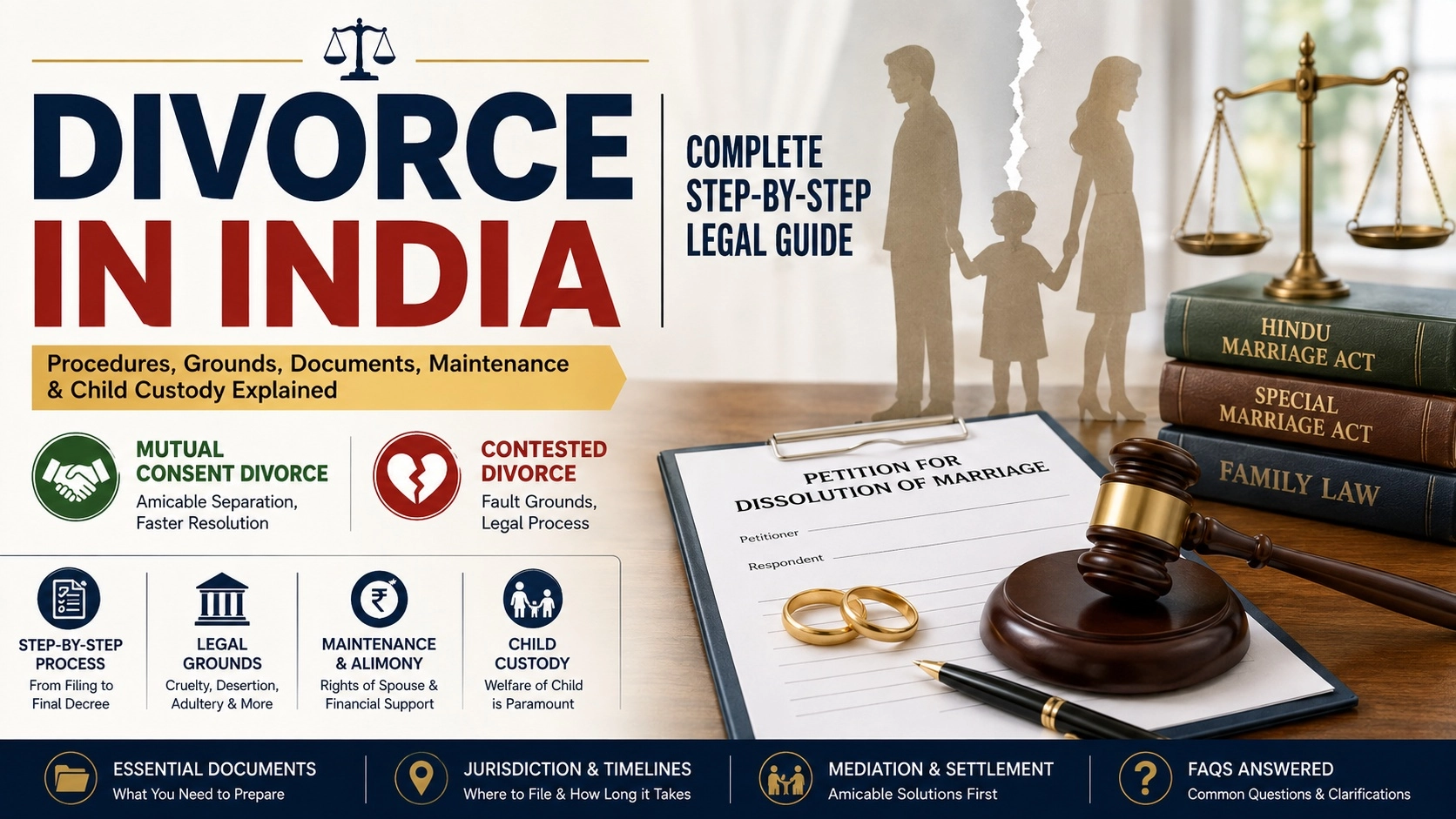
Divorce in India: Complete Step-by-Step Legal Guide
Making the decision to end a marriage is emotionally difficult. Once the decision is made, stepping into the Indian family court system requires a clear understanding of the law. Many individuals face prolonged litigation simply because they do not understand the legal exit routes, jurisdiction rules, or maintenance provisions available to them.
In India, personal laws govern marriage and divorce, meaning the procedures vary depending on your religion (Hindu Marriage Act, 1955; Special Marriage Act, 1954; Indian Christian Marriage Act, 1872; Muslim Personal Law, etc.). However, broadly speaking, divorce proceedings in India generally fall into two categories: mutual consent divorce (where both spouses agree) and contested divorce (where one spouse seeks divorce through legal grounds). The exact procedure depends on the applicable personal law.
This comprehensive guide breaks down the step-by-step legal procedure for both routes, providing clarity to help you navigate this transition.
Route 1: Divorce by Mutual Consent
Divorce by mutual consent is generally simpler, less adversarial, and faster compared with contested proceedings. It occurs when both the husband and wife agree to separate amicably.
To file for a mutual consent divorce under laws such as the Hindu Marriage Act (Section 13B) or the Special Marriage Act (Section 28), specific conditions must be met:
- The couple must generally have been living separately for at least one year before filing a mutual consent divorce petition under laws such as the Hindu Marriage Act and Special Marriage Act. The exact requirement depends on the applicable personal law. Note that "living separately" does not necessarily mean living in different physical locations; it means not living as husband and wife.
- Both parties agree that they cannot continue the marital relationship and wish to dissolve the marriage amicably.
- Both parties have reached a consensus on the settlement (alimony, property division, and child custody).
The Procedure for Mutual Consent Divorce
Route 2: Contested Divorce
When one spouse wants a divorce and the other refuses, or when both want a divorce but cannot agree on terms, a contested divorce is filed. This is a fault-based system where the petitioner must prove specific grounds recognized by law. The available grounds vary depending on the personal law governing the marriage.
Under Section 13 of the Hindu Marriage Act, some of the legally recognized grounds for a contested divorce include:
- Cruelty: Physical or mental torture. Courts have recognized various forms of mental cruelty, including sustained abusive conduct, false allegations, and in appropriate circumstances, denial of marital relations.
- Adultery: Having voluntary sexual intercourse with any person other than the spouse. Although adultery is no longer a criminal offence in India (post Joseph Shine v. Union of India), it continues to be a matrimonial ground for divorce.
- Desertion: Abandoning the spouse for a continuous period of at least two years without reasonable cause and without their consent.
- Mental Disorder: Divorce may be sought where the spouse suffers from a mental disorder of such a nature that the petitioner cannot reasonably be expected to live with them. Certain older grounds such as leprosy have been removed from the law.
- Conversion or Renunciation: If the spouse ceases to be a Hindu by converting to another religion, or renounces the world by entering a religious order.
Unlike mutual consent, a contested legal process involves drafting a petition detailing the allegations, responding with written statements, evidence gathering, cross-examinations, and final arguments. Because the burden of proof lies on the petitioner, contested divorces require substantial legal strategy.
| Feature | Mutual Consent Divorce | Contested Divorce |
|---|---|---|
| Average Timeline | 6 months to 1.5 years (can be faster if waiting period is waived). | Contested divorce may take several years, commonly ranging from 2–7 years or more depending on complexity and court workload. |
| Burden of Proof | None. The court only verifies that consent is free and genuine. | High. The petitioner must prove allegations (e.g., cruelty) with solid evidence. |
Jurisdiction, Maintenance, and Child Custody
Where to File (Jurisdiction): A divorce petition cannot be filed in just any court. Generally, under the Hindu Marriage Act, it must be filed in the family court where the marriage was solemnized, where the couple last resided together, or where the wife currently resides.
Maintenance and Alimony: During and after a divorce, dependent spouses can claim maintenance. This can be claimed under personal laws (like the Hindu Marriage Act and Hindu Adoption and Maintenance Act) or under the secular provision of Section 125 of the CrPC (now Section 144 of the BNSS). Interim maintenance may also be granted while the case is ongoing.
Child Custody: Matters of child custody are decided based on the "paramount welfare of the child," governed by statutes such as the Guardians and Wards Act and the Hindu Minority and Guardianship Act.
Essential Documents Required for Filing
Having the correct paperwork organized prevents procedural delays. Ensure you have the following documents ready:
- Marriage certificate, where available. In its absence, other proof of marriage such as wedding photographs, invitation cards, or registration records may be used depending on the circumstances.
- Proof of Identity and Address (Aadhar Card, Voter ID, Passport) for both parties.
- Four passport-size photographs of both parties.
- Income Tax Returns (ITR) and salary slips for the last three years (crucial for deciding alimony and maintenance).
- Evidence supporting allegations (medical reports, police complaints, or digital evidence) if filing a contested divorce.
What Should You Do Before Filing for Divorce?
Preparing for a divorce requires strategic and financial planning. If you are contemplating this step:
- Consider Mediation: Courts often encourage or refer matrimonial disputes to mediation where appropriate. Exploring mediation early can sometimes help transition a contested divorce into a mutual consent divorce.
- Secure Your Finances: Gather copies of joint financial assets, property documents, and tax returns.
- Prioritize the Children: Courts make custody decisions solely based on the "welfare of the child." Hostile behavior toward your spouse in front of the child will negatively impact your custody claims.
- Do Not Rush Out: Leaving the matrimonial home by itself does not automatically constitute desertion, but the circumstances surrounding separation can become relevant in matrimonial proceedings. Consult a lawyer before making sudden moves.
Frequently Asked Questions
Can I get a divorce within a few months of marriage?
Under the Hindu Marriage Act, a petition is generally barred within the first year except with court permission in cases of exceptional hardship or exceptional depravity. Other personal laws may have different provisions.
What if my spouse refuses to sign the mutual consent papers?
Mutual consent requires both parties to agree. If your spouse refuses to sign, or withdraws their consent during the waiting period, your legal option is to file a contested divorce based on fault grounds.
Can I appeal a divorce decree?
Yes. If you are dissatisfied with a contested divorce judgment (e.g., disagreeing with the alimony amount or custody arrangement), you have the right to file an appeal in the High Court, generally within a specified statutory period (often 30 to 90 days, depending on the statute and amendments).
Final Thoughts
Divorce jurisprudence in India aims to resolve disputes fairly while allowing parties to exit irrevocably broken marriages. While the procedural journey can be complex, understanding the difference between mutual consent and contested proceedings gives you the ability to make informed decisions. Secure your documentation, explore mediation, and seek counsel from an experienced family lawyer to protect your rights.
No comments yet. Be the first to share your thoughts!