
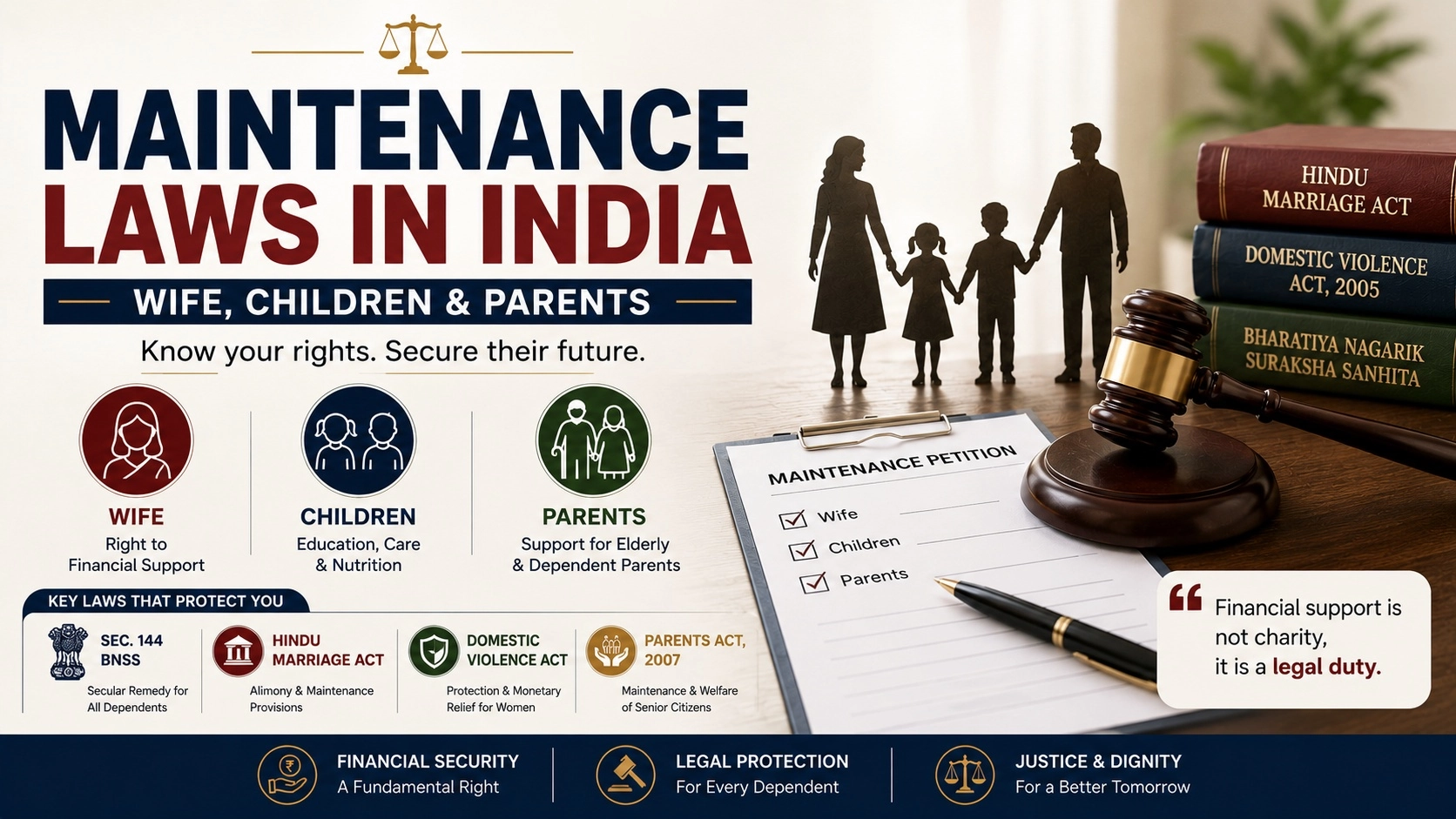
Maintenance Laws in India: Wife, Children & Parents
When family structures break down, the immediate crisis is often financial. How will a homemaker survive if she is suddenly abandoned? Who will pay for the children's education? What happens to elderly parents when their earning children turn their backs on them?
In India, providing maintenance is not just a moral obligation; it is a strict statutory duty designed to prevent financial hardship and ensure that dependents are not left without basic support. The legal framework surrounding maintenance is vast, operating through both secular laws that apply to all citizens and personal laws that apply based on religion.
This guide breaks down the core provisions, the factors courts consider when calculating maintenance, and the landmark judgments that have modernized financial rights for dependents.
Difference Between Maintenance and Alimony
Before diving into the laws, it is important to clarify a very common search query: the difference between maintenance and alimony. Maintenance refers to financial support provided to a spouse, child, or parent who is unable to maintain themselves. While the term "alimony" is often used for spousal support, maintenance is a broader legal concept encompassing the duty to support multiple categories of dependents.
The Secular Shield: Section 144 of the BNSS
The most widely used secular remedy for claiming maintenance in India is provided under Section 144 of the BNSS (formerly Section 125 of the CrPC). This section allows a Magistrate to order a person with "sufficient means" who neglects or refuses to maintain their dependents to pay a monthly allowance. The beauty of this section is its speed; it is designed as a summary procedure to provide swift financial relief.
Who can claim maintenance under Section 144 BNSS?
- Wife: A wife who is unable to maintain herself adequately and meets the statutory requirements may claim maintenance. The legal definition of "wife" here includes a divorced wife who has not remarried.
- Children: Minor children, whether legitimate or illegitimate, may claim maintenance. A child who has attained majority may also claim maintenance if unable to maintain themselves due to physical or mental abnormality.
- Parents: A father or mother who is unable to maintain themselves can claim maintenance from their adult earning children (both sons and daughters).
Maintenance Under Personal Laws
While the BNSS provides a quick secular remedy, parties often file for maintenance under their respective personal laws during divorce proceedings, which allows courts to award sums based on the standard of living rather than just basic survival.
The Hindu Marriage Act, 1955 (HMA)
Applicable to Hindus, Buddhists, Jains, and Sikhs, the HMA is unique because it is gender-neutral. Either the husband or the wife can claim maintenance from the other if they have no independent income to support themselves.
- Section 25 (Permanent Alimony): Granted at the time of passing the final divorce decree. The court may grant permanent alimony as a lump sum or periodic payments, subject to circumstances such as remarriage and other relevant factors considered by the court.
Muslim Personal Law
Traditional Muslim personal law recognized maintenance obligations during the iddat period. However, statutory remedies and Supreme Court interpretations have significantly expanded protections available to divorced Muslim women. Following the Muslim Women (Protection of Rights on Divorce) Act, 1986, the Supreme Court in Danial Latifi v. Union of India (2001) ruled that a Muslim husband must make a reasonable and fair provision for the future of his divorced wife. Furthermore, in a historic 2024 judgment (Mohd. Abdul Samad v. State of Telangana), the Supreme Court clarified that the secular maintenance remedy under Section 125 CrPC (now Section 144 BNSS) remains available to divorced Muslim women despite personal law provisions.
Maintenance Under the Domestic Violence Act
An extremely important avenue for financial relief is the Protection of Women from Domestic Violence Act, 2005 (DV Act). The DV Act goes beyond physical abuse, recognizing economic abuse as a form of domestic violence. Under the DV Act, a Magistrate can grant monetary relief to an aggrieved woman to meet expenses incurred and losses suffered as a result of domestic violence. This monetary relief is often sought simultaneously with maintenance under the BNSS or personal laws, offering an additional layer of protection.
Interim Maintenance During Matrimonial Disputes
Because divorce proceedings can take years, courts recognize that dependents cannot wait until a final judgment to survive. Interim maintenance is temporary financial support granted while the case is ongoing. This can be claimed under:
- Section 24 of the HMA (Pendente Lite): Covers monthly living expenses and the legal costs of fighting the court case.
- Section 144 BNSS / DV Act: Courts routinely pass interim orders under these secular statutes to provide immediate sustenance to wives and children pending the final disposal of the application.
How Do Courts Calculate the Maintenance Amount?
There is no fixed mathematical formula for calculating maintenance in India. Courts enjoy broad discretion, but they evaluate specific parameters to arrive at a fair figure.
| Parameter | Court's Consideration |
|---|---|
| Status and Lifestyle | Courts consider the standard of living enjoyed during the marriage while determining a reasonable maintenance amount. |
| Income and Liabilities | The net income of both parties is assessed. The court factors in the earning spouse's genuine liabilities (e.g., caring for elderly parents or prior debts) before ordering an amount. |
| Earning Capacity | Courts may consider earning capacity, qualifications, and whether a spouse is voluntarily avoiding employment while assessing maintenance. However, if a spouse sacrificed their career for household duties, they are entitled to robust support. |
Maintenance for Parents: A Statutory Duty
While the BNSS allows parents to claim maintenance through the criminal courts, the government enacted a specialized law: the Maintenance and Welfare of Parents and Senior Citizens Act, 2007.
Under this Act, parents and senior citizens who cannot maintain themselves from their own earnings or property can apply to a specialized Maintenance Tribunal. The Tribunal can order children or relatives to provide maintenance. The amount depends on statutory limits and rules applicable in the relevant jurisdiction. Proceedings are intended to be simple and accessible, and legal representation is restricted before the Tribunal under the Act, although parties may seek legal guidance where necessary.
Final Thoughts
The jurisprudence surrounding maintenance in India has evolved to become highly protective of the vulnerable. Whether you are a wife seeking to retain your dignity post-divorce, a parent ensuring your child's educational needs are met, or a senior citizen demanding support from your heirs, the law offers robust, multi-layered remedies.
With the Supreme Court's mandate requiring strict financial disclosures (Rajnesh v. Neha) and the modern secular provisions of the BNSS, courts have increasingly emphasized transparency regarding income and assets. The core message of the Indian legal system is clear: financial responsibility toward dependents cannot be shirked.
No comments yet. Be the first to share your thoughts!