
Brief Facts of the case
petitioner’s father, Raj Bahadur Patel, was allotted a fair price shop dealership in Gram Panchayat Chalakpur Kurmiyan, Block Baba Belkharnath Dham, Tehsil Raniganj, District Pratapgarh, who died on 02.11.2025, whereafter the petitioner, being his daughter and dependent, submitted an application dated 30.12.2025 seeking allotment of the said fair price shop dealership on the ground that she continued to reside with her father even after marriage and thus is a local resident fulfilling the requisite eligibility conditions, however, the said application was rejected by the Sub-Divisional Magistrate, Raniganj, Pratapgarh, vide order dated 21.01.2026.
Gournd of Rejection
she is a married daughter of the deceased allottee
Argument on behalf of petitoner
daughter, being a dependent of the deceased, cannot be denied such appointment merely on the basis of her marital status, as the same is arbitrary, unreasonable, and violative of Article 14 of the Constitution of India
Petitioner cited authority of Supreme Court of India
Kulsum Nisha v. State of U.P., 2026 SCC OnLine SC 1059
The Hon'ble Supreme Court held in Kulsum (supra)
wherein it has been held that a married daughter cannot be excluded from consideration for appointment on compassionate grounds as a fair price shop dealer solely on the ground of her marriage
Para 25 & 26 are quoted below
"25. Bearing in mind the object of the provision, that is to provide immediate financial relief to the dependent family of the deceased dealer and to ensure continuity of public distribution system, on purposive interpretation, the words “unmarried, legally separated and widowed daughters” in Clause 2(p) of 2016 Order, have to be read so as to include married daughters provided they fulfil other eligibility conditions laid down in G.O. for the following reasons:—
(i) The words “unmarried, legally separated and widowed daughters” illustrate the specific categories of daughters who are expressly included. There is no express language of exclusion. The enumeration is a description of class of daughters who by reason of remaining in or returning to natal household, are most visibly placed in position of dependency. The absence of exclusionary language in respect of married daughters reflects an illustrative and not exhaustive character of enumeration;
(ii) The 2016 Order in Clause 2(p) itself defines one of the categories of family members as “Adult children who are fully dependent on the head of the family”, without any qualification of marital status or gender.
(iii) The object of dependent quota is unambiguously welfare oriented, that is to provide for immediate financial relief to dependent family member of deceased dealer and to ensure continuity of public distribution system. Dependency and not the marital status is the governing criteria of the G.O.
(iv) The descriptive categories of daughters in Clause 2(p) of 2016 Order whether unmarried, legally separated or widowed share a common characteristic that is they remain or have returned to their natal family. They are united by functional criteria of dependency. A married daughter who has not departed from the natal household and is dependent upon it, shares the same functional characteristic.
(v) The submission that a married daughter necessarily fails to satisfy the local residence requirement and therefore cannot be a dependent, needs a factual inquiry to be made in every case. A blanket exclusion of all married daughters on such a speculative presumption is unjustified and is constitutionally untenable.
(vi) To read the words “unmarried, legally separated and widowed daughters” in Clause 2(p) of 2016 Order would produce a result which is inconsistent with constitutional guarantees under Articles 14 and 15(1) as the same would amount to exclusion of a married daughter on a gender-based stereotype which is constitutionally impermissible.
(vii) The exclusion of married daughter who is dependent upon the deceased dealer and resides with the family and is a capable of running the fair price shop would directly frustrate the purpose of the provision. To sum up, the expression “daughter” in Clause 2(p) of 2016 Order, has to be read to include a married daughter provided she establishes the dependency on the deceased dealer and satisfies all other eligibility conditions prescribed under the G.O. including the requirement of local residence.
26. For the foregoing reasons, on a purposive construction of Clause 2(p) of 2016 Order, we hold that the expression “daughters” used in the aforesaid provision includes a married daughter who furnishes a dependency certificate along with No Objection Certificates from other adult family members of the deceased dealer and is a local resident and satisfies all other eligibility conditions prescribed in the G.O. The provision, so construed, would neither suffer from any invalidity nor any constitutional infirmity. It is saved by the very meaning it bears when understood in the light of its purpose."
Observation of Hon'ble Justice ARUN KUMAR SINGH DESHWAL, J. in para 15 same is qouted below;
"15. From the above analysis as well as the law laid down by the Hon’ble Apex Court in the aforesaid cases, it is clear that a married daughter is also included within the definition of “family” and is entitled to apply for appointment as a fair price shop dealer after the death of her father or mother, subject to fulfillment of other eligibility conditions such as local residence, no objection from other adult family members, and other prescribed requirements."
Result of the Writ Petiton
i. That the Hon'ble High Court Lucknow has allowed the writ petition.
ii. set a side the order passed by the Sub-Divisional Magistrate, Raniganj, Pratapgarh, vide order dated 21.01.2026.
iii. remit back for consideration in view of law laiddown by Hon'ble Apex Court
iv. keeping in mind observation made by Hon'ble High Court
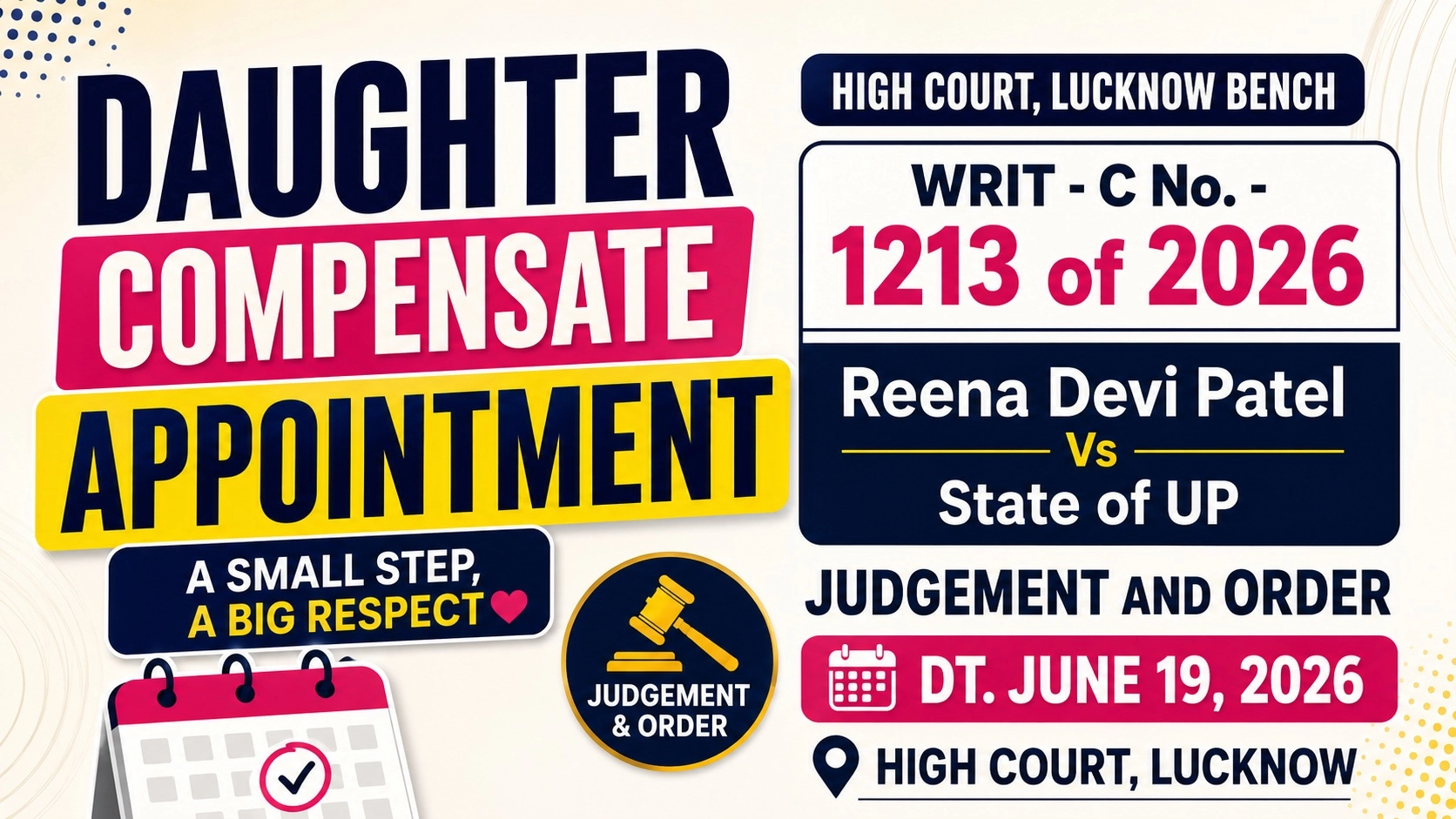
HIGH COURT OF JUDICATURE AT ALLAHABAD LUCKNOW
WRIT - C No. - 1213 of 2026
Reena Devi Patel Vs. State of UP & Ors
Date of Judgement and Decision 19/6/2026
https://elegalix.allahabadhighcourt.in/elegalix/WebDownloadJudgmentDocument.do?judgmentID=13463101
https://t.me/sajjadhusainlaw/367
No comments yet. Be the first to share your thoughts!