
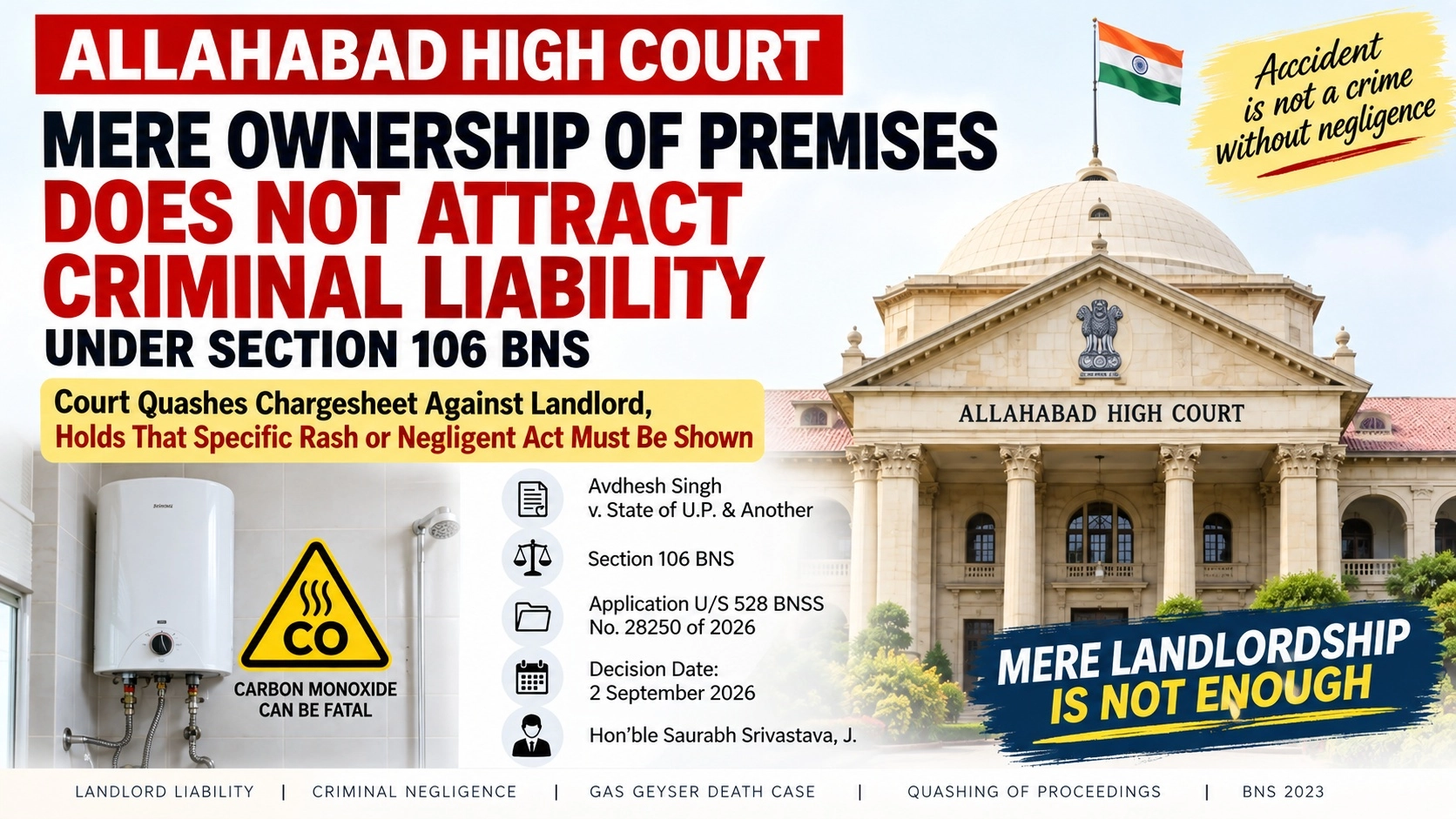
The Allahabad High Court has quashed criminal proceedings against a landlord who was prosecuted under Section 106 of the Bharatiya Nyaya Sanhita, 2023 (BNS) in connection with the death of a young student allegedly caused by inhalation of Carbon Monoxide gas from a gas geyser installed in the bathroom of the rented premises.
Section 106 BNS — Causing Death by Negligence.
The bench of Justice Saurabh Srivastava
The Court emphasized that criminal liability for causing death by negligence requires prima facie material demonstrating a rash or negligent act attributable to the accused and having a direct and proximate nexus with the death. Mere ownership of the premises cannot create vicarious criminal liability.
Facts of the Case
Opposite party no. 2 lodged an FIR against the applicant, Avdhesh Singh, alleging that his son had been residing as a tenant in the applicant's house at Kanpur Nagar for approximately eight months while preparing for the IIT examination.
The prosecution case arose from the death of the tenant, whose body was allegedly found inside the bathroom of the premises under suspicious circumstances. A gas geyser was installed in the bathroom, and it was alleged that the geyser might have emitted carbon monoxide. It was further alleged that the bathroom had inadequate ventilation and that inhalation of carbon monoxide resulted in the death.
An FIR was registered as Case Crime No. 06 of 2025, Police Station Kakadev, District Kanpur Nagar, under Section 106 BNS. After investigation, the police submitted a chargesheet against the applicant. The Magistrate thereafter took cognizance and passed the summoning order dated 15 November 2025.
The applicant approached the High Court under Section 528 BNSS, seeking quashing of the chargesheet, cognizance/summoning order and the entire criminal proceedings.
Findings of the Allahabad High Court
The Court acknowledged that the death of a young student was undoubtedly unfortunate. However, it held that mere occurrence of death in premises belonging to an accused is insufficient to establish criminal liability under Section 106 BNS.
There must be prima facie material demonstrating a rash or negligent act attributable to the accused, together with a direct and proximate nexus between that act and the death.
No Specific Act of Gross Negligence
The Court found that, apart from the applicant being the owner/landlord of the premises, no specific act of gross negligence had been attributed to him.
Importantly, the record did not indicate:
- that the applicant had installed the geyser in violation of any prescribed safety standard;
- that the geyser was defective to his knowledge;
- that any earlier complaint concerning leakage or malfunction had been made to him
- that he had been informed about any danger and nevertheless deliberately failed to take corrective measures.
The Court also noted that the deceased had lived in the premises for approximately eight months and there was no material showing that, during this period, any complaint regarding the geyser, bathroom ventilation or another hazardous condition had been communicated to the applicant.
Absence of Essential Link
The Court found that the essential link between the allegedly dangerous condition and any specific rash or negligent act of the applicant was missing.
Thus, although the circumstances surrounding the death could be unfortunate and may raise questions regarding the safety of the premises, those circumstances alone did not establish the ingredients of the criminal offence.
The Court specifically concluded that the ingredients necessary for constituting an offence under Section 106 BNS were not prima facie made out against the applicant.
Decision of the Court
In view of its findings, the Allahabad High Court allowed the application.
The Court quashed:
- the chargesheet dated 7 September 2025;
- the cognizance/summoning order dated 15 November 2025; and
- the entire criminal proceedings arising out of Case Crime No. 06 of 2025 under Section 106 BNS, Police Station Kakadev, District Kanpur Nagar.
Legal Principle Emerging from the Judgment
The judgment lays down an important principle concerning prosecution for death caused by negligence:
Mere ownership or possession of premises where an accidental death occurs does not, by itself, establish criminal negligence.
For prosecution under Section 106 BNS, there must be prima facie material showing:Rash or negligent act/omission → attributable to the accused → directly and proximately connected with the death.
In other words, criminal liability cannot be imposed merely because the accused happens to own the premises where the accident occurred.
Case: Avdhesh Singh v. State of U.P. and Another
Court: High Court of Judicature at Allahabad
Application: U/S 528 BNSS No. 28250 of 2026
Judge: Hon’ble Saurabh Srivastava, J.
Offence: Section 106, BNS
Decision: Application allowed; chargesheet and criminal proceedings quashed
Date: 2 September 2026
Mere ownership of the premises cannot create vicarious criminal
liability for an accidental death unless the prosecution material discloses a
legally attributable negligent act or omission on the part of the owner.
Mere ownership of the premises cannot create vicarious criminal
liability for an accidental death unless the prosecution material discloses a
legally attributable negligent act or omission on the part of the owner.
MMere ownership of the premises cannot create vicarious criminal
liability for an accidental death unless the prosecution material discloses a
legally attributable negligent act or omission on the part of the owner.ere ownership of the premises cannot create vicarious criminal
liability for an accidental death unless the prosecution material discloses a
legally attributable negligent act or omission on the part of the owner.
No comments yet. Be the first to share your thoughts!