
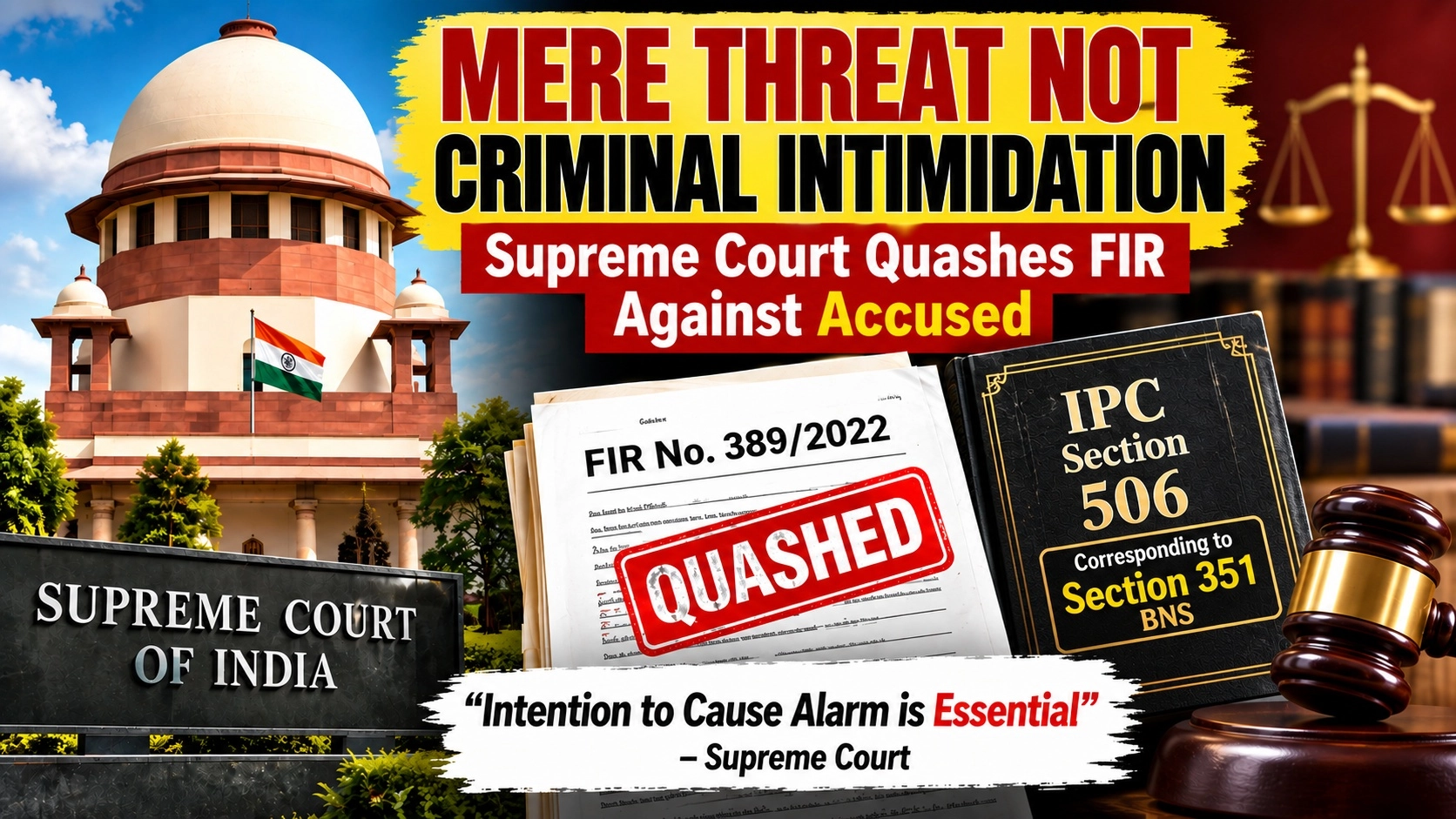
Beri Manoj v. State of Andhra Pradesh & Anr.
Supreme Court of India — Order dated 20 January 2026
Criminal Appeal arising out of SLP (Crl.) No. 14741/2025
Brief Summary
The Supreme Court allowed the appeal and quashed the FIR proceedings against the appellant, Beri Manoj, while directing that the case would continue against the other accused. The Court principally found that the allegation of criminal intimidation under Section 506 IPC,
Firstly definiation of Criminal Intimidation define under section 503 IPC Corresponding section 351 BNS 2023 is reproduced herewith as under,
" 503. Criminal intimidation.—Whoever threatens another with any injury to his person, reputation or property, or to the person or reputation of any one in whom that person is interested, with intent to cause alarm to that person, or to cause that person to do any act which he is not legally bound to do, or to omit to do any act which that person is legally entitled to do, as the means of avoiding the execution of such threats, commits criminal intimidation
Explanation.—A threat to injure the reputation of any deceased person in whom the person threatened is interested, is within this section.
Illustration
A, for the purpose of inducing B to desist from prosecuting a civil suit, threatens to burn B's house. A is guilty of criminal intimidation.
From perusal of section 503 IPC corresponding section 351 BNS 2023 is Criminal initmidation define as a defination cluase, and punushment is provided under 506 IPC corresponding section 351(3) BNS 2023, same is reproduce as under;
"506. Punishment for criminal intimidation.—Whoever commits the offence of criminal intimidation shall be punished with imprisonment of either description for a term which may extend to two years, or with fine, or with both;
if threat be to cause death or grievous hurt, etc.—and if the threat be to cause death or grievous hurt, or to cause the destruction of any property by fire, or to cause an offence punishable with death or 496[imprisonment for life], or with imprisonment for a term which may extend to seven years, or to impute unchastity to a woman, shall be punished with imprisonment of either description for a term which may extend to seven years, or with fine, or with both.
was based on a significant improvement in the prosecutrix's statement and lacked prima facie material showing the required intention to cause alarm.
Facts of the Case
- FIR No. 389/2022 was initially registered against three persons.
- After investigation, a chargesheet was filed against five persons, with the appellant arraigned as Accused No. 5 under Sections 328, 376 and 506 IPC read with Sections 3/4 POCSO Act.
- The principal allegation against the appellant was criminal intimidation under Section 506 IPC.
- In her Section 161 CrPC statement, the prosecutrix did not allege that the appellant had threatened her; she merely stated that she had gone to his house.
- However, about seven days later, in her Section 164 CrPC statement, she alleged that an uncle and two aunts had threatened her and told her to support the main accused.
Supreme Court's Main Findings
1. Material improvement in the statement
The Court found a clear improvement between the Section 161 and Section 164 statements. The appellant's name surfaced only after seven days through a vague reference to “an uncle.” According to the Court, this created serious doubt regarding the prosecution version.
2. Mere threat is not sufficient for Section 506 IPC
The Supreme Court relied upon Naresh Aneja v. State of U.P. (2025) 2 SCC 604 and Sharif Ahmad v. State of U.P. (2024) 14 SCC 122, holding that mere threats, without the intention to cause alarm, do not constitute criminal intimidation under Section 506 IPC.
3. Intention to cause alarm is essential
The Court emphasized that prosecution for criminal intimidation requires a clear intention to cause alarm. The fact that the victim may actually have been alarmed is not by itself sufficient where the required intention is absent.
4. Vague allegations cannot sustain prosecution
The allegation against the appellant was essentially a vague reference to “an uncle”, unsupported by prima facie cogent evidence. The Court held that such vague allegations were insufficient to disclose an offence under Section 506 IPC.
5. Lawyer performing professional duty
The Court additionally observed that the mere presence of a lawyer while giving legal advice or suggestions in the course of professional duty cannot amount to criminal intimidation.
Final Decision
The Supreme Court:
- Allowed the appeal.
- Set aside the High Court's order.
- Quashed FIR No. 389/2022 insofar as it related to Beri Manoj.
- Clarified that the proceedings against the other accused would continue before the jurisdictional trial court.
Key Legal Principle
For an offence of criminal intimidation under Section 506 IPC, there must be prima facie material showing an intention to cause alarm. A vague allegation of threat, particularly where it represents a material improvement over the earlier statement and is unsupported by cogent evidence, cannot by itself justify continuation of criminal proceedings.
Download Judgment on following links
https://api.sci.gov.in/supremecourt/2025/45431/45431_2025_16_12_67600_Order_20-Jan-2026.pdf
No comments yet. Be the first to share your thoughts!