
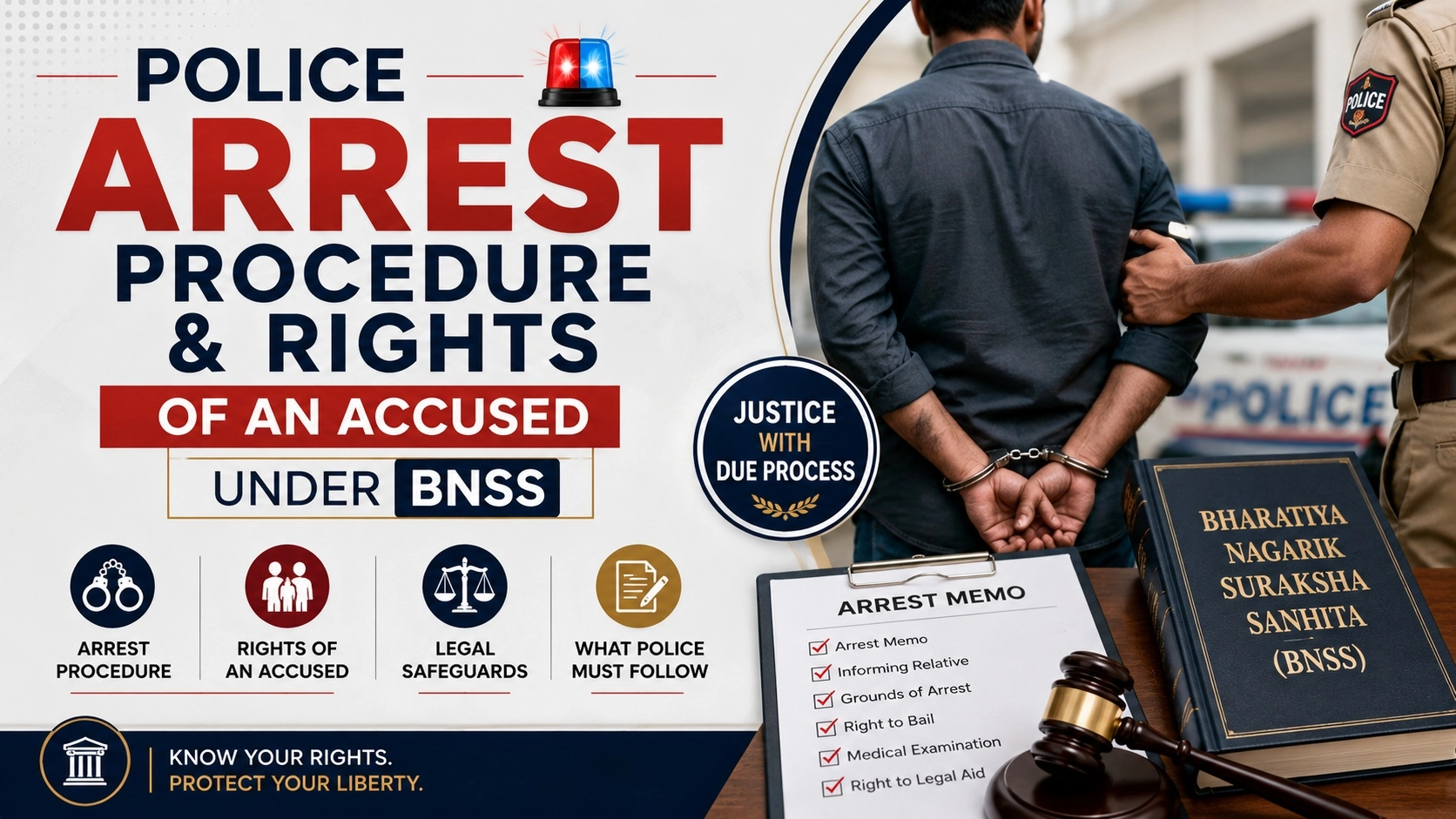
Police Arrest Procedure & Rights of an Accused under BNSS
It's late at night. There is a sudden, loud knock at the front door. When you open it, several police officers are standing there, demanding that you come with them to the station immediately for questioning regarding an ongoing investigation. In that high-pressure, intimidating moment, what to do if police arrest you? Do you know what your legal rights are? Can police arrest without a warrant in India? Can they interrogate you without a lawyer present?
The power to arrest is one of the most coercive powers wielded by the State. Historically, the arbitrary use of this power has led to severe human rights violations, custodial violence, and unwarranted harassment of citizens. To curb this, the Constitution of India and criminal procedural codes have woven a safety net of rights for the accused. With the enactment of the Bharatiya Nagarik Suraksha Sanhita (BNSS), which replaces the old Code of Criminal Procedure (CrPC), the laws governing arrest, search, and police custody have seen significant modernizations.
So, what exactly happens when the police arrive? Let's navigate the legal realities of the arrest procedure and the strict rights of an arrested person under Indian law within the new regime.
Can Police Arrest Without a Warrant in India?
The general rule in criminal law is that the police require a warrant from a Magistrate to arrest a person. However, there is a massive exception: Cognizable Offenses. If an individual is accused of committing a cognizable offense (serious crimes such as murder, rape, robbery, or severe fraud), the police possess the statutory authority to arrest them without a warrant.
But this power is not absolute. Where the offence is punishable with imprisonment up to seven years, Section 35 BNSS requires the police officer to consider the necessity of arrest and record reasons. Where arrest is not required, a notice of appearance must generally be issued. If the accused complies with the notice and cooperates with the investigation, they generally shall not be arrested unless the police record specific, compelling reasons in writing.
The Legal Checklist: BNSS Section 35 Arrest Procedure
If the police proceed with an arrest, they must adhere to a strict procedural checklist. Many safeguards developed through constitutional jurisprudence, including the D.K. Basu guidelines, continue to influence arrest procedure under BNSS. Failure to follow mandatory arrest safeguards can expose officers to judicial scrutiny, departmental action, and may affect the legality of the detention.
- Preparation of the Arrest Memo: The arresting officer must prepare an arrest memo at the exact time and place of the arrest. This crucial document must detail the date and time of the arrest and must be attested by at least one witness (preferably a family member or a respectable person from the locality). The arrested person must also countersign this memo.
- Right to Inform a Relative: Immediately upon arrest, the police are legally obligated to inform a nominated relative, friend, or well-wisher about the arrest and the exact location where the accused is being held.
- Information of the Grounds of Arrest: An accused cannot be kept in the dark. The police must clearly communicate the full particulars of the offense and the specific grounds for the arrest. In Pankaj Bansal v. Union of India (2023), the Supreme Court unequivocally held that communicating the grounds of arrest in writing is mandatory to validate the arrest.
- Information Regarding Bail: If the arrest is for a bailable offense, the police officer must inform the accused that they are entitled to be released on bail and that they may arrange for sureties on their behalf.
Rights of Arrested Person Under Indian Law
Once inside the police station, the vulnerability of the accused increases exponentially. To protect against coerced confessions and physical abuse, the law provides robust safeguards during custody.
Firstly, the accused has important safeguards relating to medical examination. The accused has a right to medical examination after arrest, particularly to document injuries or allegations of custodial abuse. This creates a baseline medical record, making it extremely difficult for the police to inflict injuries during interrogation and pass them off as pre-existing.
Secondly, regarding legal counsel, the accused has the constitutional right to consult and be defended by a lawyer of their choice. However, Indian law does not generally provide an unrestricted right for a lawyer to remain present throughout the entire police interrogation.
Furthermore, under Article 39A of the Constitution and the Legal Services Authorities Act, there is a fundamental Right to Free Legal Aid. An accused who cannot afford legal representation has the absolute right to receive free legal aid at the expense of the State.
Most importantly, the Constitution guarantees the Right Against Self-Incrimination (Article 20(3)). The accused has the right to remain silent. The police can interrogate the suspect, but they cannot use physical force, threats, or psychological torture to extract a confession. Under Indian law, a confession made to a police officer while in custody is generally not admissible as evidence in court unless it leads to the discovery of a new physical fact.
| Procedural Step | Old Code (CrPC) | New Code (BNSS) |
|---|---|---|
| Police Custody Duration | Capped at a strict maximum of 15 days immediately following the arrest. | Permits police custody up to a total of 15 days, but depending on the category of offence, this custody may be authorised during the first 40 or 60 days of judicial custody. |
| Arrest of Women | No arrest after sunset or before sunrise except in exceptional circumstances. | Retains the sunset/sunrise protection but explicitly requires information of arrest to be logged in a designated district control room. |
| Role of Technology | Largely paper-based with minimal statutory tech integration. | Increases the role of technology in criminal investigation, including electronic communication, audio-video recording, and digital processes. |
The 24-Hour Rule: The Ultimate Constitutional Safeguard
The most critical safeguard against illegal police detention is the 24-hour rule, enshrined in both the Constitution (Article 22) and the BNSS. The police cannot detain an arrested person in custody indefinitely. The accused must be produced before the nearest Magistrate within 24 hours, subject to legally permitted use of audio-video electronic means (excluding the time necessary for the journey from the place of arrest to the court).
It is the Magistrate—a judicial officer, not a police officer—who reviews the arrest memo and decides the next steps. The Magistrate assesses whether the arrest is justified and legally sound. If the police require more time for interrogation, they must apply for "Police Remand," which the Magistrate may grant or deny. If denied, the accused is sent to "Judicial Custody" (a regular jail) or granted bail.
What Should You Do If Police Arrest You?
This article explains the law, but a person facing arrest needs immediate action points. If you find yourself in this situation, keep this checklist in mind:
- Stay calm and cooperate: Do not resist physically; it can lead to additional charges.
- Ask the reason and grounds of arrest: You have a right to know in writing.
- Request information of a family member: Ensure the police log this notification.
- Ask for legal aid: If you are unable to afford a lawyer, state this clearly.
- Do not sign blank papers: Read everything thoroughly before signing.
- Do not make involuntary statements: Exercise your right to remain silent.
- Ask for a medical examination: Especially if you are injured or suspect custodial abuse.
Frequently Asked Questions
Can police arrest without a warrant in India?
Yes, police may arrest without a warrant in cognizable offences, subject to BNSS safeguards.
Can police call me to the station without arrest?
Yes, police may issue a notice of appearance (under Section 35 BNSS) where arrest is not necessary.
Can police beat a person during interrogation?
No. Custodial violence and coercion violate constitutional protections and are strictly illegal.
Can police refuse to tell the reason for arrest?
No. Grounds of arrest must be communicated, and courts have held that this should ideally be in writing.
What Lies Ahead in Criminal Procedure
The overhaul of criminal procedures through the BNSS is designed to integrate technology and streamline investigations, but it places unprecedented responsibility on the judiciary to prevent police overreach. The new provision allowing police custody to be requested in fragments will undoubtedly face immense scrutiny before the constitutional courts.
For citizens, legal literacy is no longer a luxury. Knowing that the police must issue a notice for lesser offenses, demanding the preparation of an arrest memo, understanding your right to legal aid, and insisting on immediate medical examination are the practical shields against abuse. As the new laws take root, the true test will be on the ground—whether the digital monitoring and modernized procedures of the BNSS translate into a fairer, more transparent criminal justice system, or simply arm the State with sharper tools.
No comments yet. Be the first to share your thoughts!