
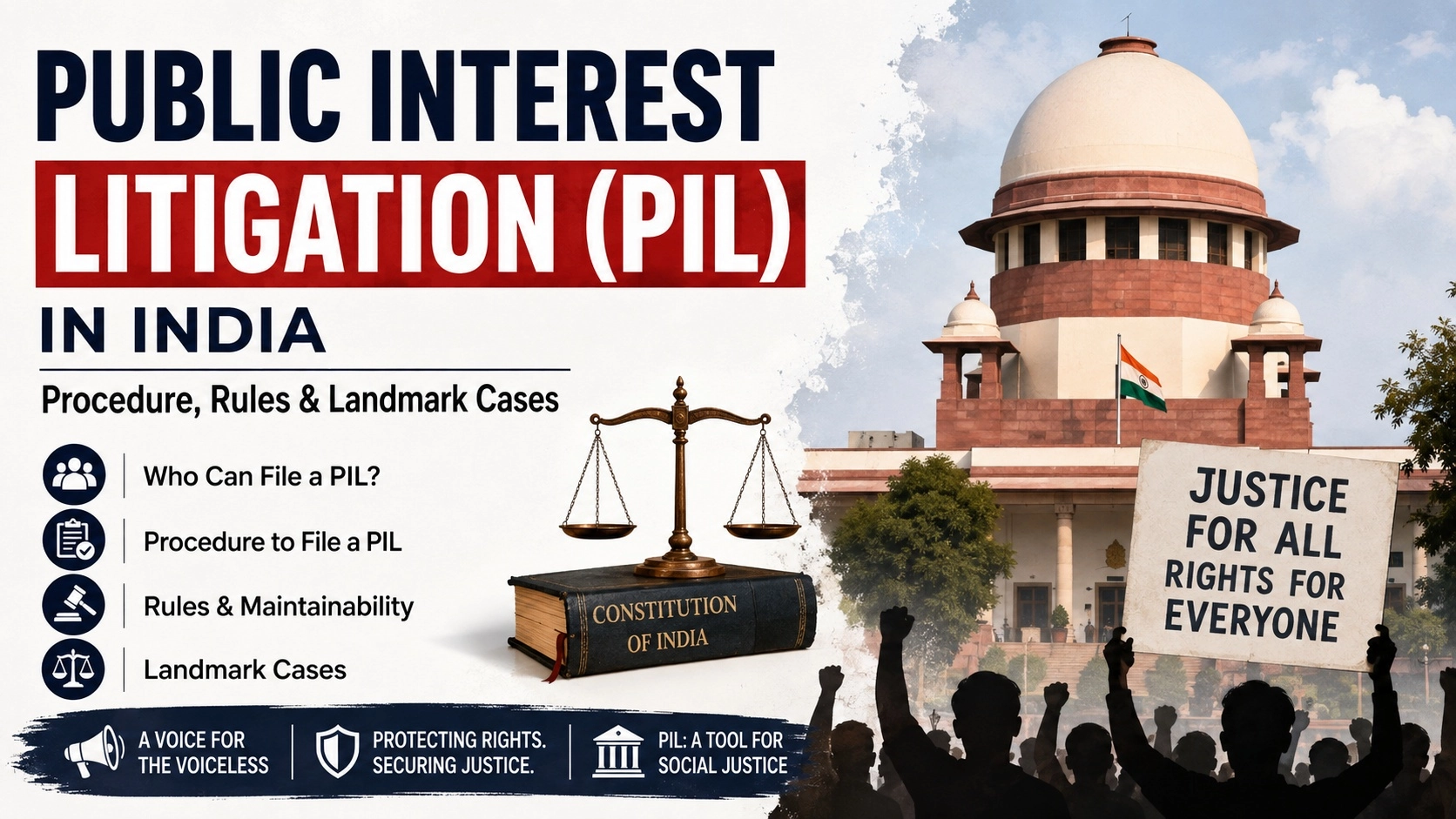
Public Interest Litigation (PIL) in India: Procedure, Rules & Landmark Cases
Imagine a scenario where thousands of citizens are wrongfully imprisoned, but because they are entirely impoverished, they have no means to hire a lawyer or approach the courts. Under traditional legal rules, they would simply be left to languish, because the law demanded that a victim must personally file their own case. That was the grim reality in India until the late 1970s. Everything changed when a few visionary judges began to relax these strict rules, eventually allowing the doors of the Supreme Court to be opened by a simple letter or postcard sent by a concerned citizen on behalf of those without a voice. This gradual but radical shift gave birth to Public Interest Litigation (PIL)—a tool that has since cleaned rivers, protected fundamental rights, and improved the accountability of public authorities.
Public Interest Litigation represents one of the most powerful and transformative mechanisms available in Indian jurisprudence. Rooted in the principles of social justice, PILs ensure that the marginalized sections of society—such as bonded laborers, undertrial prisoners, and environmental victims—receive justice. The underlying philosophy is simple: the courts are not exclusively accessible to the wealthy or those with a direct, personal legal injury. Instead, the judicial system must address broad public grievances.
The Evolution of PIL: From Rigid Standing to Epistolary Jurisdiction
The traditional rule of Locus Standi (the right to be heard in court) strictly dictated that only the person whose rights were directly infringed could file a lawsuit. In a developing nation where the majority lacked financial resources and legal awareness, this rigid doctrine proved woefully inadequate. Realizing this, stalwarts of the Indian judiciary—most notably Justice P.N. Bhagwati and Justice V.R. Krishna Iyer—began to relax these strict rules.
Who Can File a PIL?
The relaxation of the standing rule is the cornerstone of Public Interest Litigation. However, this does not mean that absolutely anyone can file a PIL for any trivial or personal reason. The courts have laid down specific parameters to prevent the misuse of this powerful mechanism.
First, any public-spirited Indian citizen acting in good faith can file a PIL. They must not have any malicious intent, political motive, or hidden personal agenda. Second, registered non-governmental organizations (NGOs), social action groups, and civil rights bodies frequently file PILs to protect the rights of vulnerable communities or public assets. Finally, the courts themselves have the authority to initiate a PIL on their own motion (suo motu) based on media reports or letters that highlight a gross violation of fundamental rights.
Maintainability: What Counts as "Public Interest"?
Filing a PIL is a serious legal undertaking. The Supreme Court has established stringent guidelines to determine the maintainability of a PIL, ensuring that the court's valuable time is not wasted on frivolous matters. The core test is whether the petition addresses a genuine public wrong or widespread injury.
| Category | Generally Entertained as PIL | Strictly Excluded from PIL |
|---|---|---|
| Human Rights & Labor | Bonded labor, neglected children, exploitation of workers, non-payment of minimum wages. | Individual service matters, pension claims, gratuity disputes (except for large groups). |
| Justice & Administration | Police harassment, prisoner rights, atrocities against vulnerable groups (women, Dalits). | Complaints against specific government bodies that are purely personal in nature. |
| Civil Matters & Property | Environmental pollution, preservation of heritage, food adulteration affecting masses. | Landlord-tenant disputes, private property quarrels, individual medical/engineering admission cases. |
The Step-by-Step Procedure to File a PIL
While the concept is designed to be accessible, filing a PIL remains a formal legal process. It can be filed in the Supreme Court (under Article 32) or in a High Court (under Article 226). To prevent abuse, Supreme Court guidelines mandate several strict requirements for a PIL petition:
- Full Disclosure: The petitioner must fully disclose their credentials, demonstrating their genuine public spirit.
- No Personal Interest: An explicit declaration must be made that the petitioner has no personal, financial, or political interest in the litigation.
- Previous Litigation History: Details of any previous litigation filed by the petitioner must be disclosed to establish a track record of bona fide public service.
- Evidence-Backed Claims: The petition must be supported by adequate documents, affidavits, and empirical evidence (e.g., RTI replies, official reports).
When it comes to the actual filing, the petition must comply with the procedural rules of the concerned court, including specific formatting, the filing of necessary affidavits, annexures, and other registry requirements. Once filed and cleared of defects, the matter is listed for admission. The judge evaluates if it constitutes genuine public interest before issuing notices to the respondents or appointing an Amicus Curiae.
Landmark Judgments That Shaped the Nation
PILs have led to some of the most historic and socially significant judgments in Indian legal history. Here are some of the cornerstone cases:
1. Hussainara Khatoon v. State of Bihar (1979)
One of the earliest PILs, this case recognized the "Right to a Speedy Trial" as a fundamental right under Article 21. Following judicial intervention regarding the plight of those languishing in Bihar jails, thousands of undertrial prisoners were eventually released.
2. Bandhua Mukti Morcha v. Union of India (1984)
A watershed case for labor rights, where an NGO highlighted the miserable conditions of bonded laborers in stone quarries. The Supreme Court established that the right to live with human dignity (Article 21) inherently prohibited the practice of bonded labor.
3. Olga Tellis v. Bombay Municipal Corporation (1985)
In a defining judgment for urban poor, the Supreme Court ruled that the "Right to Life" encompasses the "Right to Livelihood," preventing the arbitrary eviction of pavement dwellers without offering alternative accommodation or giving them the right to be heard.
4. M.C. Mehta v. Union of India (The Ganga Pollution Case)
Advocate M.C. Mehta filed numerous PILs that became the bedrock of Indian environmental law. The Ganga pollution cases strengthened environmental jurisprudence and contributed to principles such as absolute liability and stringent pollution control measures against erring industries.
5. Vineet Narain v. Union of India (1997)
A major anti-corruption PIL that led to the Supreme Court directing sweeping reforms in the functioning of the Central Bureau of Investigation (CBI) and the Central Vigilance Commission (CVC), emphasizing the necessity of insulating these investigative agencies from political interference.
6. Vishaka v. State of Rajasthan (1997)
Following the Bhanwari Devi incident, Vishaka and other women's rights groups filed a PIL seeking the enforcement of fundamental rights for working women. In the absence of domestic laws regarding workplace sexual harassment, the Supreme Court formulated the binding "Vishaka Guidelines," which culminated in the 2013 POSH Act.
Moving Forward: The Delicate Balance
Public Interest Litigation remains one of the most dynamic components of the Indian legal system. It has successfully democratized access to justice, ensuring that the highest courts of the land serve as sanctuaries for the poorest and most marginalized, rather than just arenas for the wealthy to settle private disputes. By checking governmental apathy, expanding the scope of fundamental rights, and protecting the environment, PIL has proven indispensable.
However, the future of PIL depends on striking a delicate balance. The courts must remain fiercely vigilant against frivolous petitions that clog the judicial system and obscure genuine grievances. When utilized with integrity, thorough research, and a true commitment to the public good, a PIL is not just a legal document—it is a catalyst for national transformation.
No comments yet. Be the first to share your thoughts!