
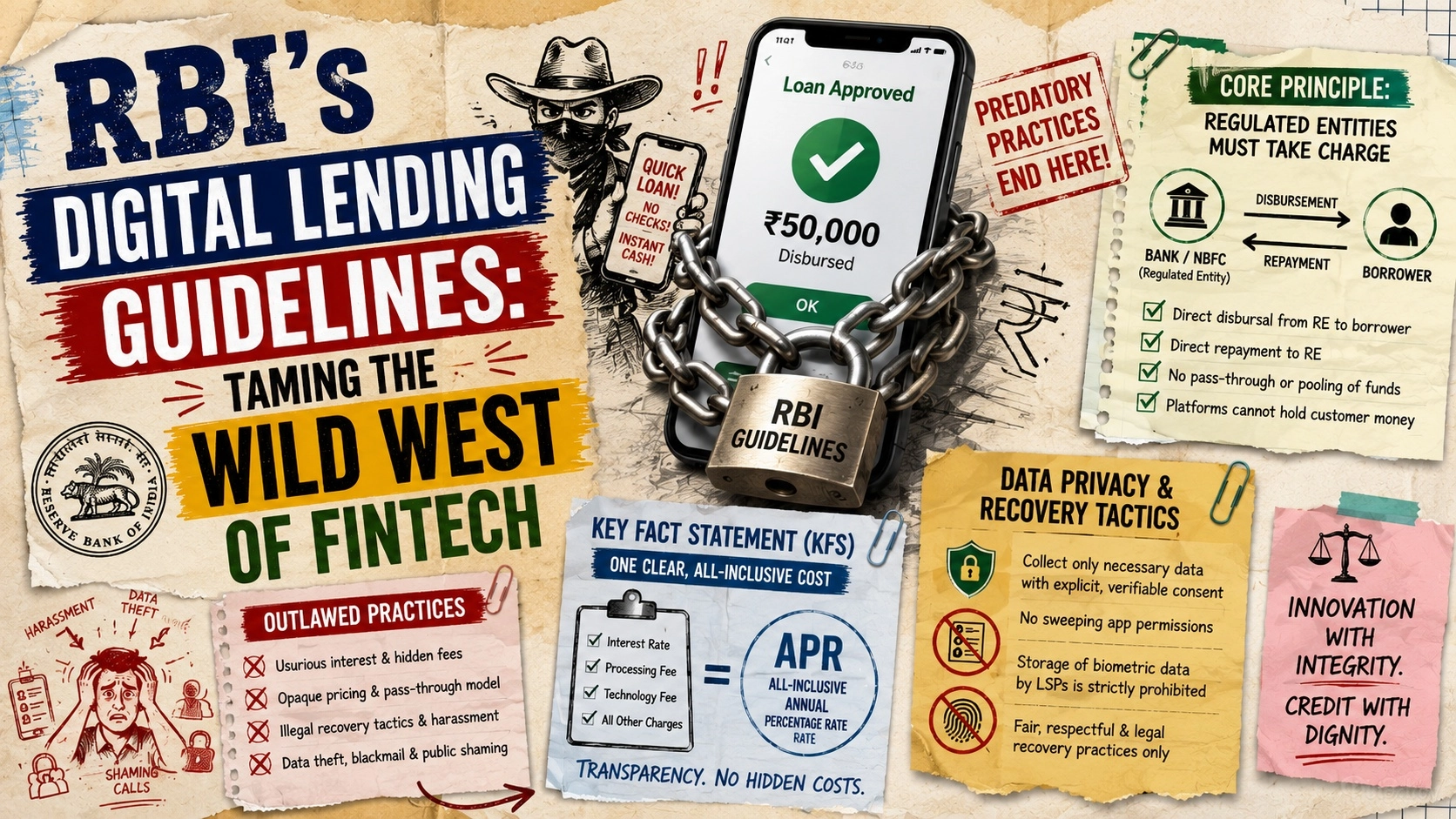
RBI's Digital Lending Guidelines: Taming the Wild West of Fintech
The explosive growth of fintech in India brought unprecedented financial inclusion, but it also birthed a dark underbelly: predatory digital lending apps. Unregulated platforms engaged in usurious interest rates, opaque processing fees, and aggressive, often illegal, recovery tactics involving data theft and public shaming. In response to mounting public outcry and a surge in borrower suicides, the Reserve Bank of India (RBI) introduced a comprehensive regulatory framework designed to tame the digital lending ecosystem.
These guidelines represent a massive shift in how fintech companies (Lending Service Providers or LSPs) must interact with their partner banks and Non-Banking Financial Companies (NBFCs). The RBI's legal mandate is clear: technological innovation cannot come at the expense of consumer protection and fundamental data privacy.
The Core Principle: Regulated Entities Must Take Charge
The foundational pillar of the RBI's guidelines is accountability. The central bank refuses to regulate tech platforms directly; instead, it places the entire regulatory burden on the Regulated Entities (REs)—the banks and NBFCs that provide the actual capital.
Previously, a fintech startup could act as a black box, accepting funds from an NBFC, disbursing them to a borrower, collecting repayments, and taking a massive cut in the middle. The RBI has outlawed this "pass-through" model. Now, all loan disbursals must be executed directly from the bank account of the RE to the borrower’s bank account. Similarly, all repayments must go directly back to the RE.
This ensures that the tech platform never holds the customer's money, significantly reducing the risk of systemic fraud and forcing transparency regarding the actual source of funds.
The Key Fact Statement (KFS) and Transparent Pricing
One of the most predatory tactics used by illegal loan apps was hiding exorbitant fees in the fine print. A borrower might agree to a 15% interest rate, only to be hit with a 20% "processing fee" and a 10% "technology fee" upon disbursement.
To legally combat this, the RBI mandated the issuance of a standardized Key Fact Statement (KFS) to the borrower before the execution of the contract. The KFS must contain an all-inclusive Annual Percentage Rate (APR). This APR must calculate the interest, processing fees, and all other charges to present one single, undeniable percentage cost of the loan.
| Regulatory Aspect | Pre-Guidelines Environment | Current RBI Mandate |
|---|---|---|
| LSP Fees | Charged directly to the borrower by the app. | Must be paid by the Regulated Entity (NBFC/Bank), not the borrower. |
| Cooling-off Period | Non-existent. Borrowers were locked in immediately. | Mandatory window for borrowers to exit the loan without penalty by returning the principal. |
Data Privacy and Recovery Tactics
The most egregious violations by rogue apps involved data privacy. Apps would scrape a user's contact list and photo gallery, using this stolen data to blackmail borrowers who missed a payment by threatening to send defamatory messages to their family and employers.
The RBI has laid down strict legal guardrails regarding data collection. Apps can no longer demand sweeping permissions. They can only collect data strictly necessary for underwriting, and they must obtain explicit, verifiable consent for each data point accessed. Furthermore, the storage of biometric data by Lending Service Providers is strictly prohibited.
Moving Forward
The RBI's Digital Lending Guidelines have forced a massive legal restructuring within the Indian fintech industry. Companies that relied on regulatory arbitrage and opaque fee structures are struggling to adapt, while compliant platforms are building deeper integrations with their banking partners to ensure seamless, direct fund flows.
For consumers, these regulations provide a much-needed legal shield against predatory practices, ensuring that the digital lending revolution continues to offer accessible credit without compromising financial safety or personal dignity.