
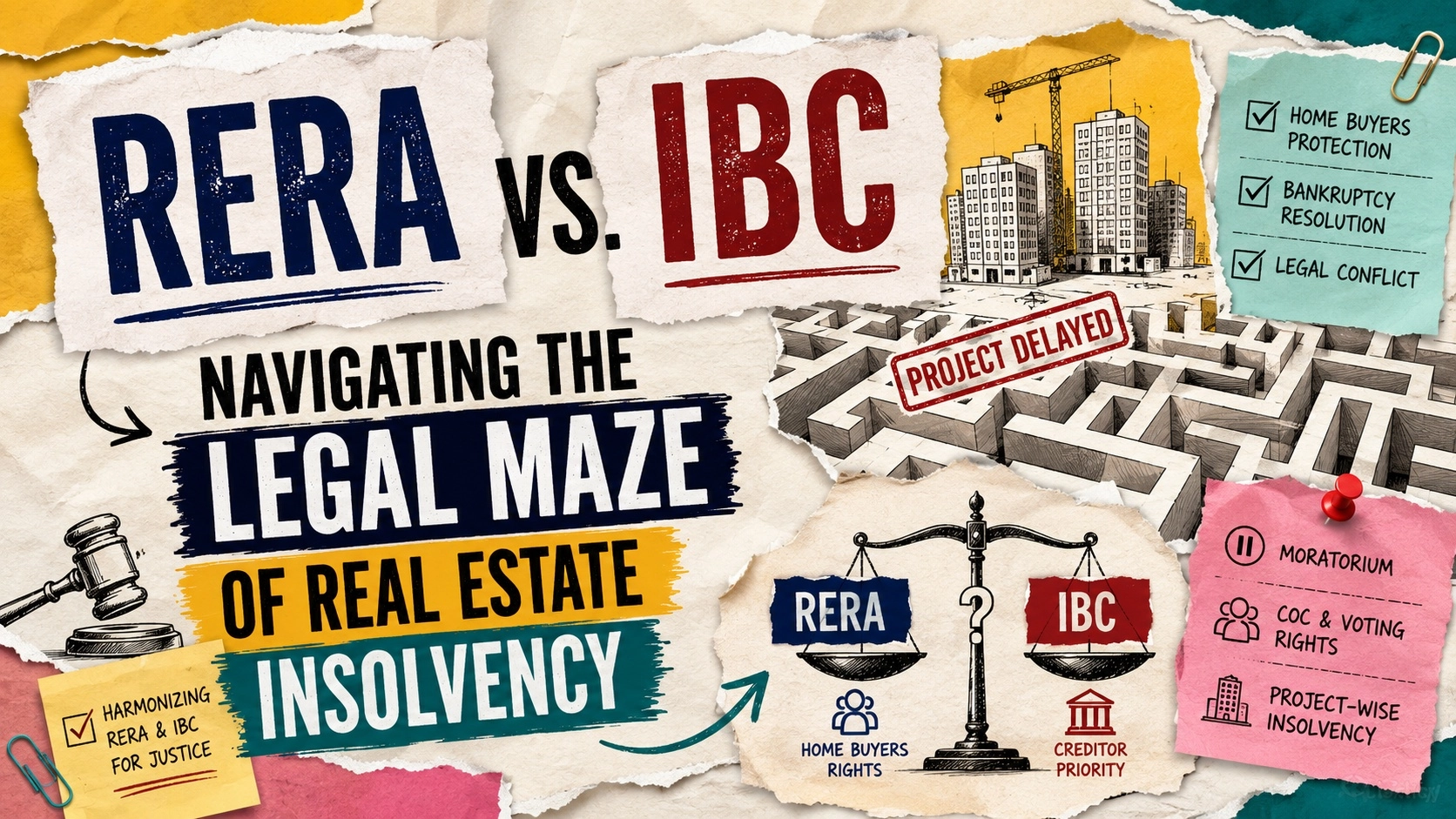
RERA vs. IBC: Navigating the Legal Maze of Real Estate Insolvency
The Indian real estate sector has historically been plagued by massive project delays, siphoning of funds, and developer bankruptcies, leaving thousands of middle-class homebuyers stranded with incomplete apartments and hefty EMI burdens. To combat this, the government enacted two monumental pieces of legislation in 2016: the Real Estate (Regulation and Development) Act (RERA) to protect homebuyers, and the Insolvency and Bankruptcy Code (IBC) to resolve corporate defaults.
However, when a developer goes bankrupt, these two laws often collide. Homebuyers armed with favorable RERA orders demanding refunds suddenly find themselves legally paralyzed when banks (financial creditors) drag the same developer into the IBC process, triggering an automatic legal freeze. Navigating this legislative intersection is currently one of the most complex challenges in Indian corporate and real estate law.
The Status of Homebuyers: From Unsecured to Financial Creditors
Initially under the IBC, homebuyers were treated as mere "unsecured creditors." This meant if a developer was liquidated, banks and operational creditors got paid first, leaving homebuyers with nothing. Following widespread protests and massive litigation, the IBC was amended in 2018 to legally recognize homebuyers as "Financial Creditors."
This was a watershed moment. As financial creditors, homebuyers gained a seat at the all-important Committee of Creditors (CoC) and acquired voting rights on the resolution plan for the bankrupt developer. Most importantly, it gave them the legal standing to initiate the Corporate Insolvency Resolution Process (CIRP) themselves against a defaulting builder.
The Overriding Effect of the IBC
The core legal conflict arises from Section 238 of the IBC, which states that the IBC shall have an overriding effect over any other law that is inconsistent with its provisions. The Supreme Court of India, in the landmark *Pioneer Urban Land and Infrastructure* case, affirmed this stance.
This means that the moment the National Company Law Tribunal (NCLT) admits an insolvency petition against a developer, a legal moratorium is declared. All pending cases in consumer courts and all execution proceedings at RERA tribunals are immediately stayed. For a homebuyer who spent years fighting in RERA to get a refund order, the IBC moratorium feels like a severe injustice, as their hard-won RERA decree is reduced to a mere "claim" submitted to the Resolution Professional.
| Feature | RERA (Real Estate Act) | IBC (Insolvency Code) |
|---|---|---|
| Primary Objective | Protect consumer interests; ensure project completion or refund. | Resolve corporate insolvency; maximize asset value for all creditors. |
| Nature of Relief | Individualistic. Grants refunds/compensation to specific aggrieved buyers. | Collective. Seeks a comprehensive resolution plan for the entire company. |
Project-Wise Insolvency: A Pragmatic Solution
Applying the standard IBC procedure to a massive real estate company often leads to disastrous results. If a developer has 10 projects, and only one is severely distressed, initiating corporate insolvency against the entire company halts construction on the 9 healthy projects as well, punishing thousands of unrelated homebuyers.
To address this absurdity, the courts and the Insolvency and Bankruptcy Board of India (IBBI) have evolved the concept of "Reverse CIRP" or "Project-Wise Insolvency." Instead of taking over the entire parent company, the NCLT allows the resolution process to be restricted solely to the specific defaulting project. The promoter is allowed to continue funding and completing the project under the strict supervision of the Resolution Professional, bypassing the need to find a third-party buyer for the defunct company.
Moving Forward: Harmonizing the Laws
While the IBC holds legal primacy, courts are increasingly recognizing that RERA and IBC must be read harmoniously. RERA remains the specialized forum for regulating the daily conduct of builders and resolving standard project delays. The IBC is the nuclear option, invoked only when the developer has suffered a complete financial breakdown.
For legal practitioners advising distressed homebuyers, the strategy has shifted. Securing a RERA refund order is still valuable as it crystallizes the debt. However, homebuyers must remain vigilant; if the developer is teetering on bankruptcy, mobilizing 10% of the project's allottees to initiate IBC proceedings might be the only way to secure a seat at the negotiating table before institutional banks liquidate the developer's assets entirely.