
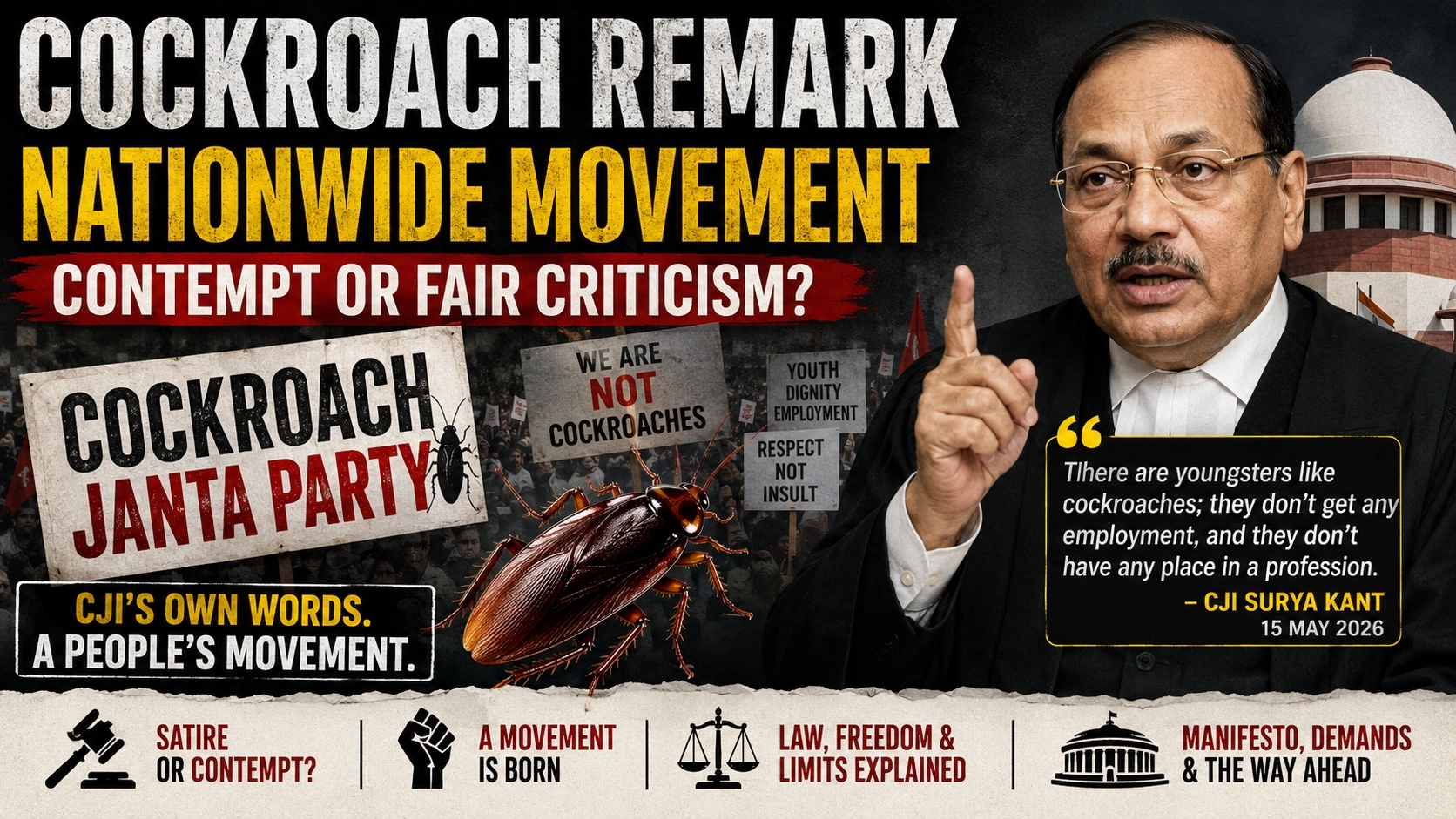
Can you call a sitting Chief Justice's own words absurd, and turn that into a nationwide movement, without landing in contempt of court? The Cockroach Janta Party has spent ten weeks testing that exact question, and the answer says as much about the limits of contempt law as it does about the remark that started it all.
On 15 May 2026, while hearing a contempt matter about delayed senior-advocate designations and unprofessional conduct by lawyers online, Chief Justice of India Surya Kant, sitting alongside Justice Joymalya Bagchi, observed that unemployed young people drifting into activism were "like cockroaches" who "don't get any employment, and don't have any place in a profession." He later clarified that he meant only individuals inflating their credentials with fake degrees, and separately praised India's youth as "the pillars of a developed India." The clarification did not stop a 24-year-old strategist, Abhijeet Dipke, from registering a satirical outfit the next day under the name that has since become a household term: the Cockroach Janta Party (CJP).
"There are youngsters like cockroaches; they don't get any employment, and they don't have any place in a profession." — CJI Surya Kant, Supreme Court hearing, 15 May 2026
The obvious legal question is whether mocking a judge's own remark — turning it into a party name, a manifesto, and a protest slogan — amounts to "scandalising the court," the branch of criminal contempt under Section 2(c)(i) of the Contempt of Courts Act, 1971 that punishes speech lowering the authority or dignity of a court. No contempt proceeding has actually been initiated against the CJP over its name or its satire, and Indian contempt jurisprudence gives a fairly clear reason why.
Fair criticism has always been a defence, not an afterthought
Section 5 of the 1971 Act expressly protects "fair criticism of a judicial act" from being treated as contempt, and Section 4 similarly shields a fair, accurate report of judicial proceedings. The Supreme Court's own precedent in P.N. Duda v. P. Shiv Shankar (1988) held that the judiciary is not above criticism, provided the criticism stays within certain limits. Reading that precedent alongside the 1971 Act, three questions tend to decide which side of the line a piece of criticism falls on:
- Is it aimed at a specific, identifiable statement or ruling — rather than a vague, sweeping claim about the judiciary as a whole?
- Is it based on an accurate account of what was actually said, rather than a distorted or invented version of it?
- Does it seek to inform public opinion, rather than to intimidate a judge or obstruct a live case?
Mocking a specific, publicly reported comparison — one the CJI himself later softened — answers "yes" to all three, which is why it sits much closer to fair criticism of a judicial act than to an attack on the judiciary's authority as such.
| Protected fair criticism | Contempt (scandalising the court) |
|---|---|
| Targets a specific remark or ruling and its reasoning | Attacks the institution's integrity or impartiality wholesale |
| Based on an accurate account of what was said or decided | Relies on distortion, fabrication, or imputed motive |
| Aims to inform or persuade public opinion | Aims to intimidate a judge or obstruct pending proceedings |
There is a genuine irony worth naming here: "contempt of court" is itself one of the specific grounds under Article 19(2) on which the Constitution permits the state to impose reasonable restrictions on the fundamental right to free speech guaranteed by Article 19(1)(a). Free speech law and contempt law are not separate universes — contempt is the exception written directly into the free-speech clause. The CJP episode has, so far, stayed on the permitted side of that boundary, precisely because its target has been a single quoted remark rather than a claim that the judiciary as a whole is corrupt or compromised.
If the remark itself can't be "appealed," what can be?
A separate question the movement's manifesto raises — its demand barring Chief Justices from post-retirement Rajya Sabha nominations — points to a real gap: there is no judicial mechanism to formally sanction a sitting judge for an intemperate remark short of the constitutional impeachment process under Articles 124(4) and 218, which requires "proved misbehaviour or incapacity" and a two-thirds parliamentary majority. Since 1997, the judiciary has also operated an internal "in-house procedure," developed in the wake of In re: K. Veeraswami, for complaints against judges that fall short of impeachable misconduct — but that mechanism is confidential, non-statutory, and has no public complaint window for an ordinary citizen or a protest movement to invoke.
That gap is precisely why the CJP's five-point manifesto reads as a political demand rather than a legal petition: no court can order a sitting Chief Justice into early retirement over a single remark, however widely criticised, and no statute currently bars a retired CJI from a Rajya Sabha seat. Changing either would require legislation or a constitutional amendment, not a writ petition — which is one reason the movement has organised as a protest and social-media campaign rather than as litigation on this specific point.
The remark that started it all remains exactly what it always was: a comment courts have chosen not to shield from public criticism. The harder questions this movement has since generated — how much force police may use against its marchers, and whether a hospitalised activist was ever really "detained" — have moved past speech law entirely, and are now the ones actually on the Delhi High Court's docket for 11 September.