
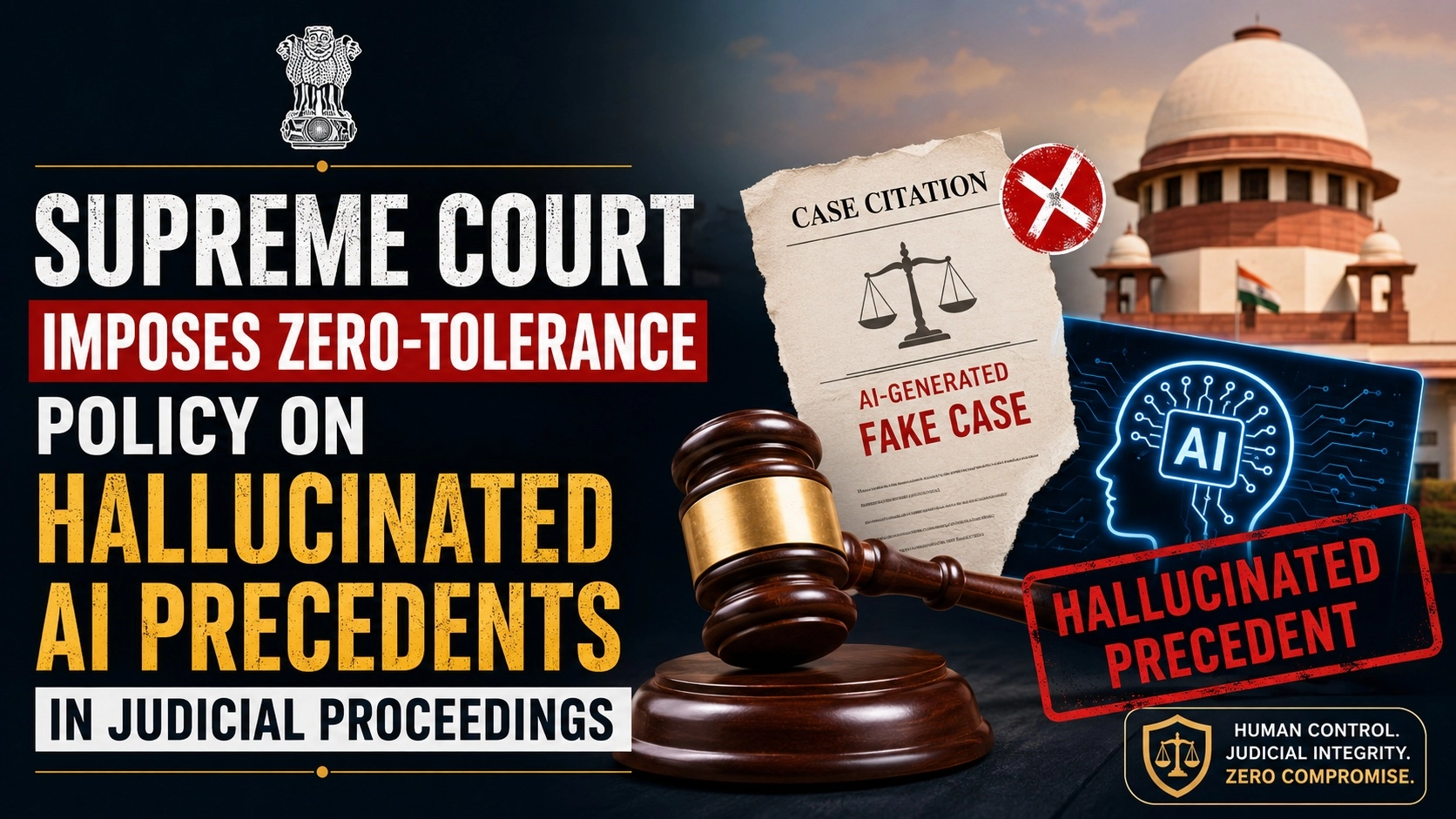
Supreme Court Imposes Zero-Tolerance Policy on Hallucinated AI Precedents in Judicial Proceedings
Case Name: Pooja Ramesh Singh v. Jammu and Kashmir Bank Ltd. & Anr.
Citation: 2026 INSC 668
Case Number: Civil Appeal No. 11950 of 2025
Coram: Justice Pamidighantam Sri Narasimha and Justice Alok Aradhe
Date of Decision: July 2, 2026
The Supreme Court of India has categorically demarcated the boundary for integrating Artificial Intelligence within the legal framework, establishing a zero-tolerance policy toward the citation of unverified, AI-generated legal precedents. In its judgment dated July 2, 2026, the two-judge Bench set aside orders previously passed by the National Company Law Tribunal (NCLT) and the National Company Law Appellate Tribunal (NCLAT) upon discovering that the lower tribunals had relied on fabricated case laws hallucinated by a generative AI model.
The ruling in Pooja Ramesh Singh v. Jammu and Kashmir Bank Ltd. & Anr. serves as a binding directive on professional misconduct, judicial oversight, and the strict limits of algorithmic reliance in Indian jurisprudence. The Court clarified that while technology remains a vital assistive mechanism for legal research, the adjudication process must remain exclusively under human cognitive control.
Factual Matrix and Procedural Irregularities
The appellate proceedings stemmed from a corporate insolvency dispute initially adjudicated by the NCLT. During the original hearings, the counsel for the respondent (Jammu and Kashmir Bank Ltd.) submitted a written compilation of judgments intended to establish precedent regarding the interpretation of statutory timelines under the Insolvency and Bankruptcy Code (IBC).
The NCLT heavily relied on a specific citation provided in this compilation, framing its final order around the supposed ratio decidendi of that case. The NCLAT subsequently upheld the NCLT’s order, affirming the application of the cited precedent. However, upon the matter escalating to the Supreme Court via a Civil Appeal, independent verification by the Supreme Court registry revealed a critical anomaly: the foundational judgment relied upon by both lower tribunals did not exist. It was a complete fabrication—a hallucination generated by a commercially available Large Language Model (LLM) utilized by the respondent's legal team for legal research.
Categorizing Professional Misconduct
The Bench addressed the responsibility of legal practitioners who introduce AI-generated content into court proceedings. The Court rejected the defense that the inclusion of the hallucinated case law was an inadvertent technological error resulting from "over-reliance" on digital tools.
Justices Narasimha and Aradhe established that the duty to verify the authenticity, citation, and factual accuracy of every precedent submitted to a court rests solely and non-delegably with the advocate on record. Citing unverified material generated by an algorithm is not merely a procedural lapse; it amounts to misleading the court and constitutes professional misconduct under the Advocates Act, 1961.
"The integration of Artificial Intelligence into legal practice cannot dilute the fiduciary duty an advocate owes to the Court. The submission of hallucinated jurisprudence fundamentally attacks the integrity of the judicial process. Human control over adjudication must remain total and absolute at every stage."
Directives for the Bar Council and Lower Courts
To prevent the recurrence of such systemic failures, the Supreme Court issued precise operational directives to both regulatory bodies and subordinate courts.
The Epistemological Danger of "Hallucinated" Jurisprudence
The judgment delved into the specific mechanics of generative AI to explain why its unsupervised use in legal reasoning is dangerous. LLMs operate on probabilistic text generation rather than logic-based factual retrieval. When prompted to find a case supporting a specific, highly nuanced legal argument, an LLM may synthetically construct a "perfect" case—inventing plausible-sounding party names, citation formats, and judicial reasoning that align with the user's prompt, despite having no basis in reality.
| Attribute | Authorized Legal Databases (e.g., SCC, Manupatra) | Generative AI / LLMs |
|---|---|---|
| Data Retrieval Mechanism | Deterministic search of indexed, historically verified court records. | Probabilistic text prediction based on statistical language patterns. |
| Output Reliability | Absolute factual accuracy regarding the existence of a judgment. | Prone to "hallucinations" (fabrication of plausible but non-existent facts). |
| Judicial Acceptability | Primary source material acceptable as binding precedent. | Unacceptable as primary authority; strictly limited to preliminary assistive research. |
The Court stressed that the judicial system relies on the unbroken chain of stare decisis. Injecting fabricated precedents into this chain not only perverts the outcome of the immediate dispute but threatens to corrupt subsequent jurisprudence if the hallucinated case is inadvertently cited by other courts.
Key Takeaways
- Voiding of Orders: The Supreme Court set aside NCLT and NCLAT orders because they were predicated on non-existent, AI-generated case law, ruling such decisions invalid.
- Professional Accountability: Advocates bear the absolute responsibility to verify every cited precedent. Submitting hallucinated case law constitutes professional misconduct.
- Regulatory Framework Required: The Bar Council of India must formulate enforceable guidelines governing the ethical deployment of AI tools by lawyers.
- Assistive, Not Adjudicative: Artificial Intelligence is recognized merely as an assistive research tool; it cannot supersede or supplement human judicial reasoning or factual verification.
- Mandatory Judicial Diligence: Lower courts and tribunals must independently authenticate cited judgments against official legal repositories before relying on them to form a ratio decidendi.
Legal Implications
Pooja Ramesh Singh v. Jammu and Kashmir Bank Ltd. acts as a necessary regulatory friction point against the uncritical adoption of legal technology. By demanding strict human oversight and imposing a zero-tolerance standard for hallucinated jurisprudence, the Supreme Court has insulated the adjudicatory process from algorithmic contamination. This judgment ensures that as the legal profession modernizes, the foundational pillars of evidence, verified precedent, and human judicial reasoning remain uncompromised.
No comments yet. Be the first to share your thoughts!