
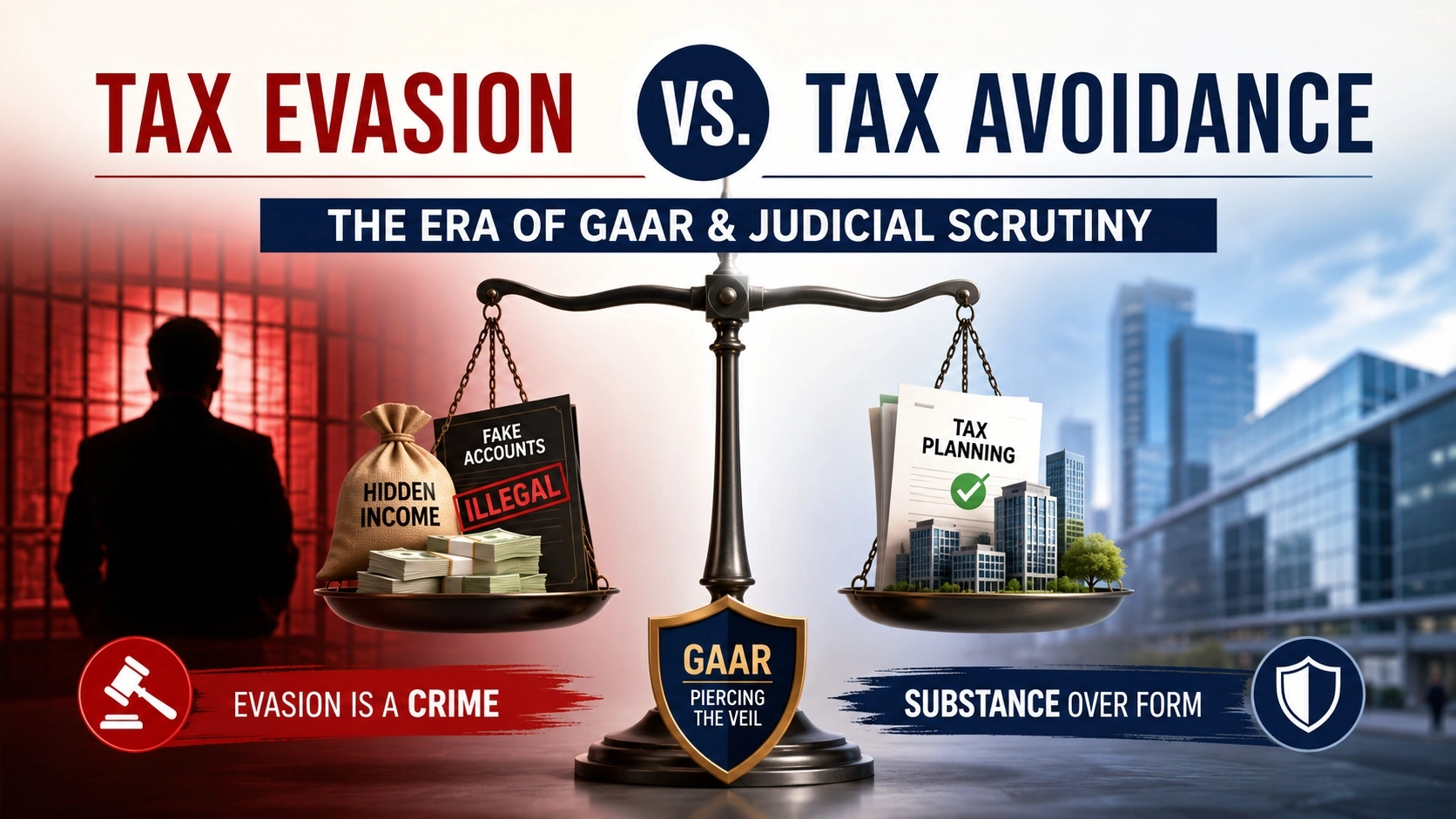
Tax Evasion vs. Tax Avoidance: The Era of GAAR and Judicial Scrutiny
For decades, Indian corporate taxation operated under a well-defined legal binary. Tax evasion—hiding income or falsifying accounts—was a crime. Tax avoidance—structuring transactions within the precise wording of the law to minimize tax liability—was considered the hallmark of smart legal planning. As the famous judicial adage went, a taxpayer is fully entitled to arrange their affairs to reduce their tax burden, provided they stay within the confines of the law.
However, the modern Indian tax landscape has undergone a seismic shift. The Income Tax Department is no longer willing to accept complex, artificial corporate structures whose only commercial purpose is to bypass tax obligations. With the operationalization of the General Anti-Avoidance Rules (GAAR) and aggressive litigation by the revenue authorities, the historical protection afforded to "tax avoidance" is rapidly eroding.
For multinational corporations and high-net-worth individuals, understanding this aggressive new legal reality is paramount when designing M&A structures, cross-border investments, or intellectual property transfers.
The Advent of GAAR: Piercing the Corporate Veil
The General Anti-Avoidance Rules (GAAR) empower the Income Tax Department with sweeping discretionary powers. Under GAAR, tax authorities can re-characterize, disregard, or completely nullify any transaction if they determine it constitutes an "Impermissible Avoidance Arrangement" (IAA).
A transaction is classified as an IAA if its main purpose is to obtain a tax benefit, and it lacks commercial substance, creates rights not ordinarily created in arm's length dealings, or utilizes the provisions of the tax law in a manner contrary to the law's intent.
The Shift in Judicial Interpretation
The impact of GAAR is amplified by a noticeable shift in how the Indian judiciary views complex tax structures. Historically, courts adhered strictly to the literal interpretation of the Income Tax Act. If the letter of the law permitted a deduction, the courts allowed it, even if it seemed contrary to the spirit of the legislation.
Today, courts heavily apply the "substance over form" doctrine. Even in cases where GAAR is not explicitly invoked, tribunals and High Courts are scrutinizing the underlying economic reality of a transaction rather than its legal paperwork. If a series of interconnected transactions (like a demerger followed immediately by a slump sale) results in massive tax savings but makes no business sense independently, the courts are increasingly ruling in favor of the revenue department.
| Concept | Historical Treatment | Treatment Under GAAR Era |
|---|---|---|
| Tax Mitigation | Perfectly legal and encouraged. | Still legal, provided there is genuine commercial substance behind the action. |
| Tax Avoidance | Viewed as "smart tax planning." | Highly risky. Artificial structures lacking business purpose will be struck down. |
The Need for "Commercial Substance"
The ultimate defense against GAAR and aggressive tax assessments is the existence of "commercial substance." Taxpayers must be prepared to prove that a transaction or corporate structure would have occurred even if no tax benefit existed.
For example, setting up a subsidiary in a low-tax jurisdiction is acceptable if that subsidiary actively conducts manufacturing, employs local staff, and generates its own sales. However, if the subsidiary merely exists as a postbox to hold intellectual property rights and charge inflated royalties to the Indian parent company (a practice known as Base Erosion and Profit Shifting), it is a prime target for anti-avoidance litigation.
Moving Forward
The implementation of GAAR marks the maturation of the Indian tax system, aligning it with global standards designed to prevent aggressive tax erosion. While tax planning remains a vital corporate function, the rules of the game have fundamentally changed.
Corporate legal and tax teams can no longer rely on hyper-technical interpretations of the law to secure tax benefits. Every major transaction must now be stress-tested against the GAAR framework, ensuring that the economic reality of the deal matches its legal form. In the current judicial climate, if a tax strategy looks "too good to be true" from a commercial perspective, the tax authorities will almost certainly declare it invalid.