
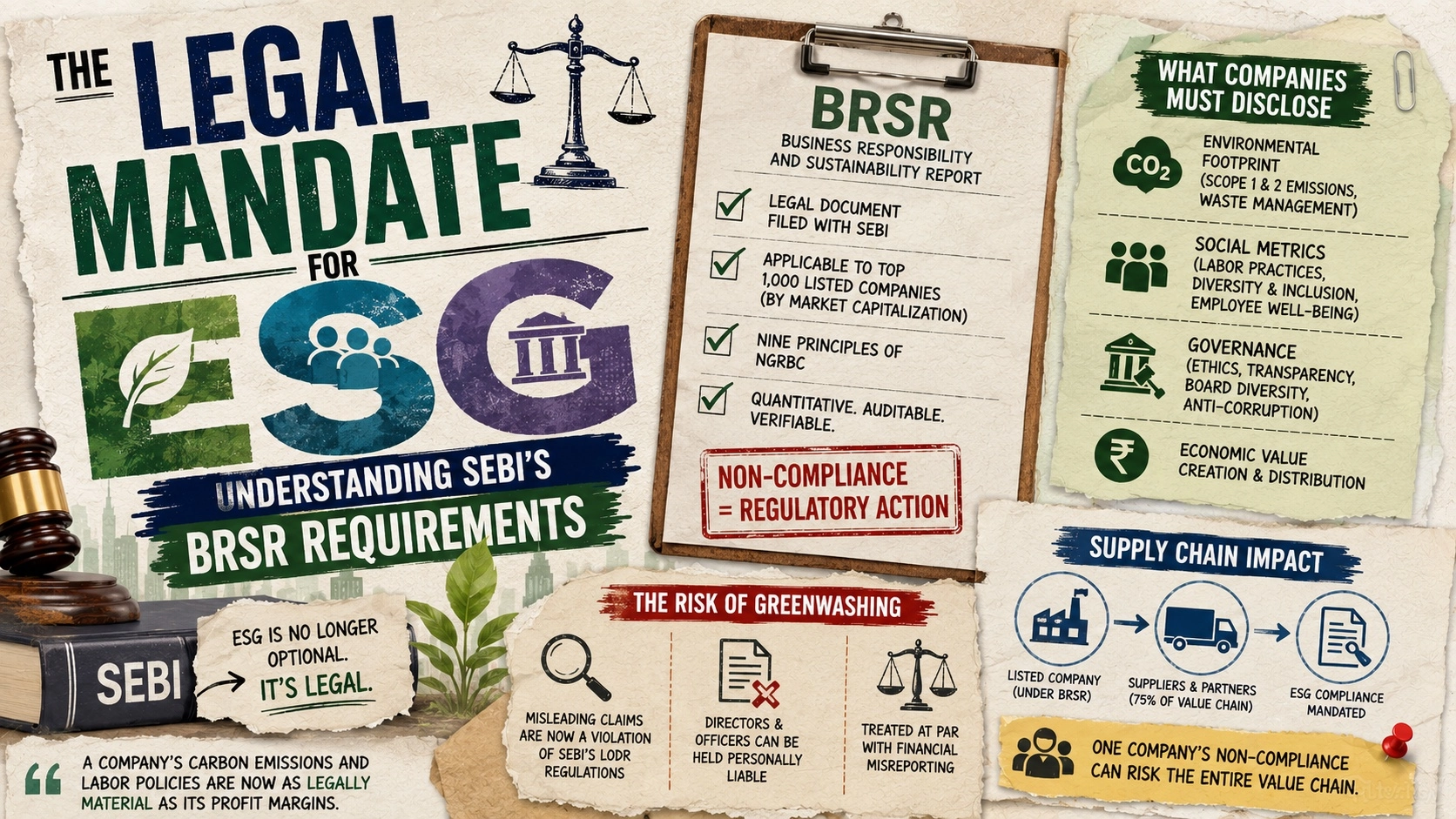
The Legal Mandate for ESG: Understanding SEBI's BRSR Requirements
For years, corporate sustainability reports were viewed primarily as public relations tools—glossy brochures highlighting tree-planting drives and charitable donations. However, a fundamental legal shift has occurred in the Indian capital markets. The Securities and Exchange Board of India (SEBI) has elevated Environmental, Social, and Governance (ESG) metrics from voluntary disclosures to strict regulatory mandates through the Business Responsibility and Sustainability Report (BRSR).
This transition represents a major legal and compliance challenge for corporate India. The BRSR framework demands quantitative, auditable data regarding a company's environmental footprint, labor practices, and supply chain ethics. For the top 1,000 listed companies (by market capitalization), failing to accurately report this data is now treated with the same severity as financial misreporting.
From Voluntary to Mandatory: The BRSR Evolution
The journey of ESG reporting in India began with the voluntary Business Responsibility Report (BRR) in 2012, applicable only to the top 100 listed entities. Over a decade, as global investors increasingly prioritized sustainable businesses, SEBI expanded the scope and rigor of these disclosures, culminating in the BRSR.
The BRSR is structured around the nine principles of the National Guidelines on Responsible Business Conduct (NGRBC). It forces companies to disclose highly specific metrics, such as Scope 1 and Scope 2 greenhouse gas emissions, solid waste management practices, gender diversity ratios across management tiers, and the median remuneration of employees compared to the Board of Directors.
The Legal Risk of "Greenwashing"
With the BRSR becoming a legal document filed with the regulator, the risk associated with "greenwashing"—making misleading or unsubstantiated claims about a company's environmental impact—has escalated dramatically. SEBI actively monitors disclosures for inconsistencies.
If a company claims in its marketing materials to be "carbon neutral" but its BRSR filings reveal increasing Scope 2 emissions without adequate offsets, it exposes itself to severe regulatory action. This is no longer just a reputational issue; it constitutes a violation of SEBI's Listing Obligations and Disclosure Requirements (LODR) Regulations. Directors and compliance officers can be held personally liable for approving false sustainability claims, just as they would be for signing off on fraudulent financial statements.
| Reporting Aspect | Old Regime (CSR/Marketing) | New Regime (BRSR) |
|---|---|---|
| Nature of Data | Qualitative narratives and selected positive highlights. | Quantitative, standardized metrics allowing direct peer comparison. |
| Supply Chain | Rarely disclosed, limited to the company's direct operations. | Value Chain Disclosures required, pushing ESG compliance down to tier-1 suppliers. |
Supply Chain Implications: The Domino Effect
Perhaps the most legally complex aspect of the BRSR is the "Value Chain Disclosure" requirement. SEBI recognizes that a company's true environmental and social impact extends far beyond its own factory walls. Large listed companies are now required to report on the ESG compliance of their significant suppliers and partners (comprising at least 75% of their value chain by purchases or sales).
This creates a massive regulatory domino effect. An unlisted, mid-sized manufacturing firm might not fall directly under SEBI's BRSR mandate. However, if that firm supplies parts to a top 1,000 listed automobile company, it will be contractually forced to adopt ESG reporting. The listed company cannot risk its own compliance status due to a supplier's poor labor practices or environmental violations. Consequently, lawyers are currently rewriting thousands of vendor contracts across India to include strict ESG indemnification clauses.
Moving Forward
The legal integration of ESG metrics into Indian corporate governance is irreversible. As global capital increasingly flows through "green" filters, regulatory bodies like SEBI are ensuring that Indian companies speak the international language of quantifiable sustainability.
For corporate boards, the BRSR is a wake-up call. ESG is no longer the sole domain of the Corporate Social Responsibility (CSR) committee; it requires the active involvement of the CFO, the legal department, and internal auditors. Navigating this new legal mandate requires a fundamental shift in corporate data collection, recognizing that a company's carbon emissions and labor policies are now just as legally material to investors as its quarterly profit margins.