
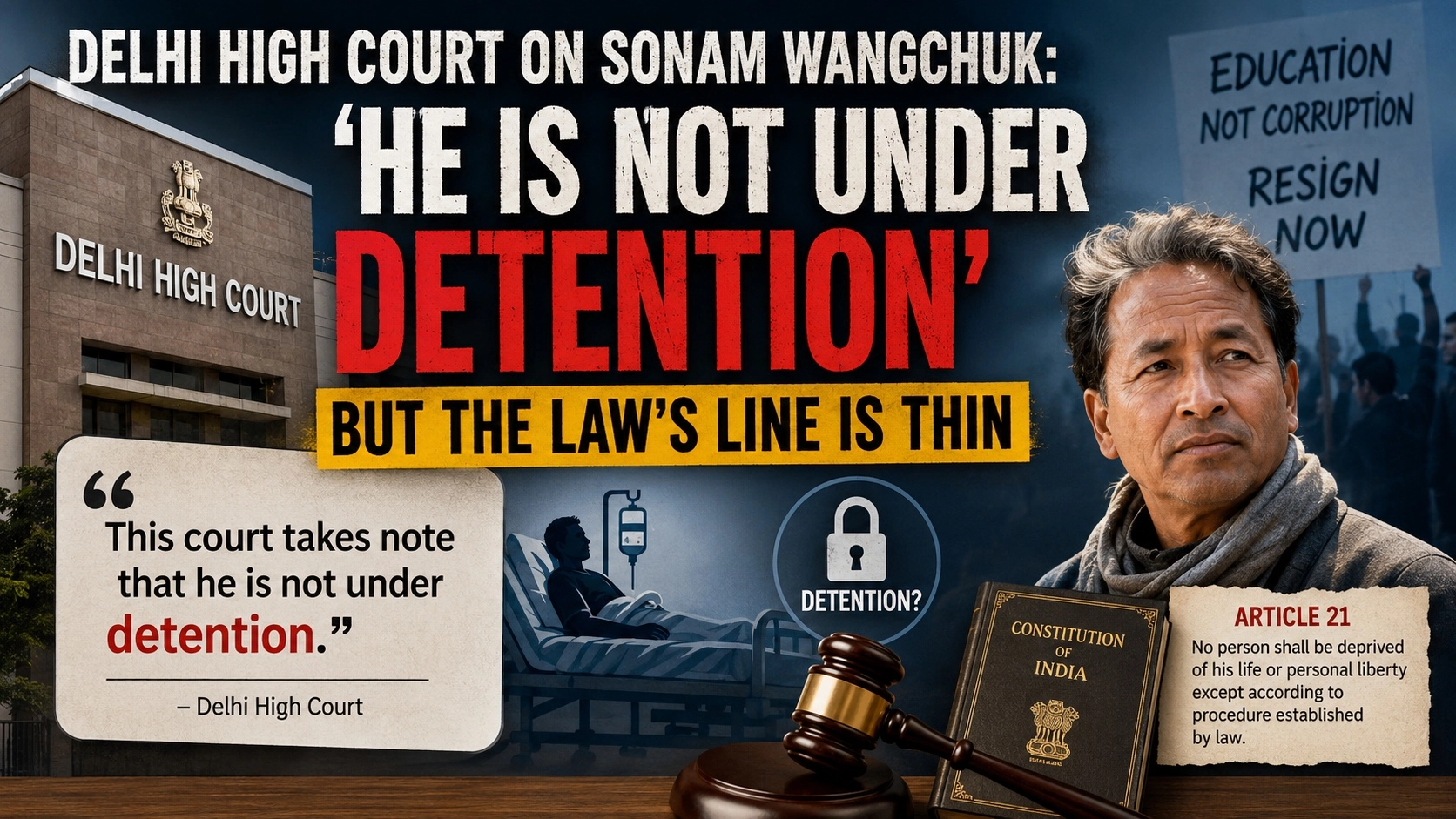
"This court takes note that he is not under detention." One sentence from the Delhi High Court, and the word doing all the work is "detention" — because whether Sonam Wangchuk was being held against his will, or simply cared for against his wishes, turns out to be a genuinely hard question under Article 21 of the Constitution.
Wangchuk, the Ladakhi engineer and climate activist, joined the Cockroach Janta Party's Jantar Mantar sit-in with a hunger strike beginning 28 June 2026, in solidarity with demands for the education minister's resignation over the NEET paper-leak controversy. On 18 July, in his third week without food, Delhi Police removed him from the protest site — under a prior court direction — and admitted him to Safdarjung Hospital. His wife, Gitanjali Angmo, went to the Delhi High Court days later, describing the move as an "illegal detention" and seeking his immediate transfer to a private hospital of the family's choosing.
"Not detention" — but not quite free, either
Justice Mini Pushkarna heard the plea first and declined it, relying on a division bench order passed on 16 July that had already sanctioned medical intervention. Her reasoning drew a specific line: because the government had taken custody of Wangchuk "on account of medical intervention," the action was not arbitrary, no force was being used against him, and his "bodily autonomy" was not being violated. On that view, keeping a hunger-striking activist under medical observation — even without his consent to end the strike — is not "detention" in the constitutional sense at all, since detention requires restraint imposed as punishment or control, not care imposed to prevent a medical emergency.
That distinction did not hold for long. Within days, the Delhi High Court reversed course on the narrower question of where Wangchuk should be treated, allowing his move from Safdarjung to Medanta Hospital and directing that a formal discharge order be issued. His hunger strike ended on 24 July — its 26th day — following negotiations with the government, and Union Education Minister Dharmendra Pradhan's resignation followed the very next day.
Procedurally, Angmo's plea functioned much like a habeas corpus petition under Article 226 — the traditional writ used to test whether a person is being unlawfully confined and to secure their production or release. Ordinarily, such a petition succeeds by establishing three things:
- That the person is in fact under someone else's physical control or custody;
- That the custody is being exercised by, or with the sanction of, the state; and
- That no valid legal provision authorises that specific confinement.
Habeas corpus petitions are ordinarily aimed at the state's coercive machinery — police custody, preventive detention, confinement in an institution — where the first two elements are usually obvious and the argument turns on the third. Using the writ against a hospital admission scrambles that pattern: the state conceded custody and state action readily enough, but framed the whole arrangement as falling outside "detention" in the first place, sidestepping the third element entirely. Once the court accepted that framing, the writ's traditional remedy of ordering immediate release had little purchase; what remained was a narrower dispute over which hospital, and under what conditions, Wangchuk would be treated.
Why "detention" is the word that matters
Article 21 guarantees that no person shall be deprived of life or personal liberty except according to procedure established by law. Since Maneka Gandhi v. Union of India (1978), the Supreme Court has read that guarantee to require any such procedure to be fair, just, and reasonable — not merely lawful on paper. If Wangchuk's hospitalisation were properly characterised as detention, the state would have needed to show a specific legal procedure authorising it and satisfying that fairness standard. By instead characterising the custody as medical care rather than restraint, the court avoided having to locate that statutory authority at all — a framing choice with real consequences for how the case could be argued.
This is not the first time Indian law has struggled with a hunger striker held by the state against their stated wishes. Irom Sharmila Chanu's decade-long fast against the Armed Forces (Special Powers) Act saw her kept in judicial custody and administered nutrition without her consent for years, on the reasoning that preventing death took precedence over honouring a fast that could end fatally. Wangchuk's case compressed a similar tension into a matter of days rather than years, but the underlying question is the same one Sharmila's case never fully settled: whether the state's interest in preserving a hunger striker's life can override that person's own choice to continue the strike, and if so, whether the resulting custody is properly called anything other than detention.
The practical resolution — moving Wangchuk to a private hospital, then discharging him once the strike ended by negotiation — arrived before the Delhi High Court had to resolve that doctrinal question outright. That is common in Indian constitutional litigation: courts frequently allow a live dispute to be overtaken by facts on the ground rather than forcing a definitive ruling, especially once the underlying grievance is politically resolved. But the underlying tension has not gone anywhere. The next hunger-striking activist the state decides to hospitalise "for their own good" will raise the identical question Wangchuk's case left open: at what point does care, administered without consent, become the very detention Article 21 requires a lawful procedure to justify.
Bottom line: calling something "medical intervention" instead of "detention" is not a technicality — it is the single finding that decided how much of Article 21's protection applied. No Supreme Court ruling has yet squared this case with Irom Sharmila's. Until one does, that label will keep deciding these cases before the merits even get argued.