
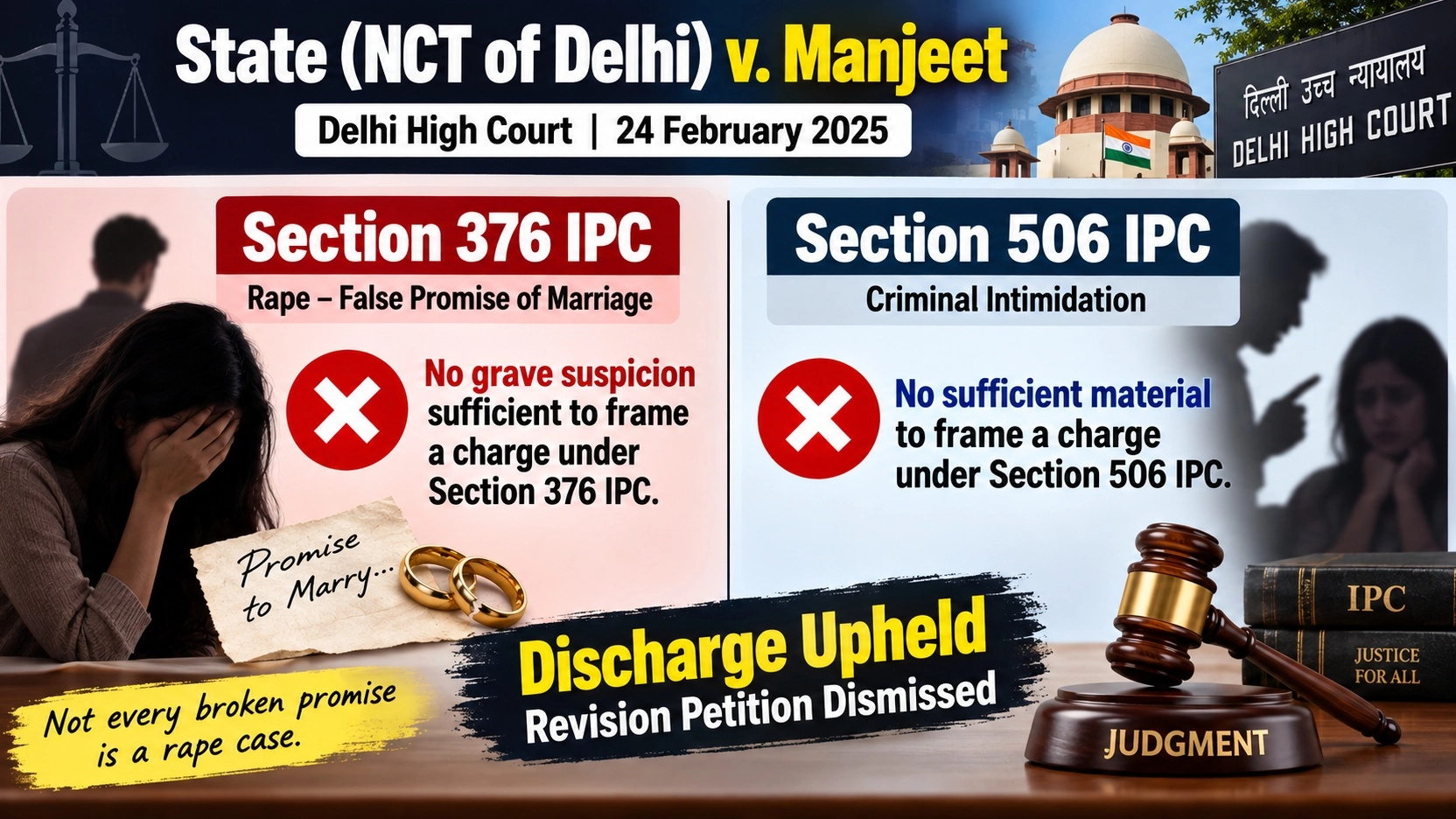
Summary of the Judgment
State (NCT of Delhi) v. Manjeet
Delhi High Court | CRL.REV.P. 554/2017 | Judgment dated 24 February 2025 | Justice Amit Mahajan
This judgment deals with two important issues:
- When does a promise to marry constitute rape under Section 376 IPC?
- When does a threat constitute criminal intimidation under Section 506 IPC?
1. Facts of the Case
The prosecutrix had known the respondent, Manjeet, since 2015. According to her complaint, Manjeet proposed marriage to her and, thereafter, they had physical relations on several occasions.
In her statement under Section 164 CrPC, she stated that some of the physical relations were consensual, while some were allegedly under pressure.
She further alleged that Manjeet repeatedly postponed the marriage and, finally, 2–3 days before the complaint, refused to marry her and expressed his intention to marry another woman.
An FIR was registered under Sections 376, 313 and 506 IPC, although the chargesheet was filed under Sections 376 and 506 IPC.
2. What did the Trial Court decide?
The Additional Sessions Judge discharged Manjeet of the offences under Sections 376 and 506 IPC.
The Trial Court considered, among other things:
- The delay in registration of the FIR.
- Absence of specific dates and times of the alleged incidents.
- The fact that the parties knew each other.
- The prosecutrix was an adult and mature enough to understand the relationship.
- The medical examination did not show external injuries.
- There was no medical evidence supporting her version.
The Trial Court therefore found that there was no grave suspicion sufficient to frame charges.
The State challenged this discharge order before the Delhi High Court.
3. What is the test at the stage of framing of charge?
The High Court referred to Union of India v. Prafulla Kumar Samal, Sajjan Kumar v. CBI, and State of Gujarat v. Dilipsinh Kishorsinh Rao.
The Court reiterated that at the stage of charge:
- The Court has to determine whether a prima facie case exists.
- It may sift and weigh the material for this limited purpose.
- It should not conduct a mini-trial or undertake a roving enquiry.
- If the material creates only suspicion, rather than grave suspicion, discharge may be justified.
- The Court must nevertheless apply its judicial mind and examine whether the ingredients of the alleged offence are disclosed.
4. False Promise of Marriage and Section 376 IPC
This is the most important part of the judgment.
The High Court explained that every failure to marry after making a promise of marriage does not amount to rape.
There is a crucial distinction between:
False Promise to Marry
If, at the very beginning, the accused had no intention of marrying the woman but made the promise only to deceive her and obtain sexual relations, the promise may amount to a false promise.
Breach of Promise
If the accused genuinely intended to marry when the promise was made but subsequently, because of unforeseen circumstances, failed to marry, it is merely a breach of promise, and does not automatically constitute rape.
The Court relied upon the principles laid down by the Supreme Court in Pramod Suryabhan Pawar, Anurag Soni, Deepak Gulati and Naim Ahmed.
5. Two conditions for a false promise to vitiate consent
The Court highlighted two essential requirements:
First: The promise to marry must have been false from the beginning, made in bad faith, with no intention of being fulfilled.
Second: The false promise must have a direct nexus with the woman's decision to engage in sexual relations.
In other words, it must be shown that the woman agreed to the sexual relationship because of that false promise.
Therefore:
Subsequent refusal to marry, by itself, is not sufficient to establish rape under Section 376 IPC.
6. Why did Section 376 IPC fail in this case?
The High Court examined the prosecutrix's Section 164 CrPC statement.
She herself stated that:
- She had known Manjeet since 2015.
- She accepted his marriage proposal.
- They had physical relations several times.
- Some relations were with her own consent.
- She alleged that some others occurred under pressure.
- Manjeet refused to marry her only 2–3 days before the complaint.
The High Court concluded that the material did not establish that she entered into the physical relationship solely because of the alleged promise of marriage.
Since she was an adult and had herself stated that some of the relations were consensual, the Court found that there was no grave suspicion sufficient to frame a charge under Section 376 IPC.
Consequently, her consent could not, on the material available at that stage, be treated as vitiated by a misconception of fact under Section 90 IPC.
7. Section 506 IPC — Criminal Intimidation
The second important issue concerned Section 506 IPC.
The allegation was that Manjeet threatened the prosecutrix that he would disclose the facts of their relationship to her mother if she did not come to him.
The High Court held that a mere threat is not sufficient to constitute criminal intimidation.
There must also be an intention to cause alarm to the complainant.
Therefore, the essential principle is:
Threat + intention to cause alarm = criminal intimidation
A threat which is not accompanied by the requisite intention to cause alarm does not constitute an offence under Section 506 IPC.
8. Final Decision
The Delhi High Court held that there was:
- No grave suspicion sufficient to frame a charge under Section 376 IPC, and
- No sufficient material to frame a charge under Section 506 IPC.
The High Court therefore found no reason to interfere with the Trial Court's discharge order.
Result:
The State's revision petition was dismissed and Manjeet's discharge under Sections 376/506 IPC was upheld.
Key Legal Takeaway
For Section 376 IPC:
A promise to marry becomes legally significant as a false promise only when there is evidence that from the inception the accused never intended to marry, and that false promise had a direct nexus with the woman's decision to have sexual relations.
For Section 506 IPC:
A mere threat is not enough. The prosecution must also establish the accused's intention to cause alarm.
This is the central ratio of State (NCT of Delhi) v. Manjeet, decided on 24 February 2025.
Find Judgment and Order
https://delhihighcourt.nic.in/app/showFileJudgment/59524022025CRLR5542017_175326.pdf
No comments yet. Be the first to share your thoughts!