
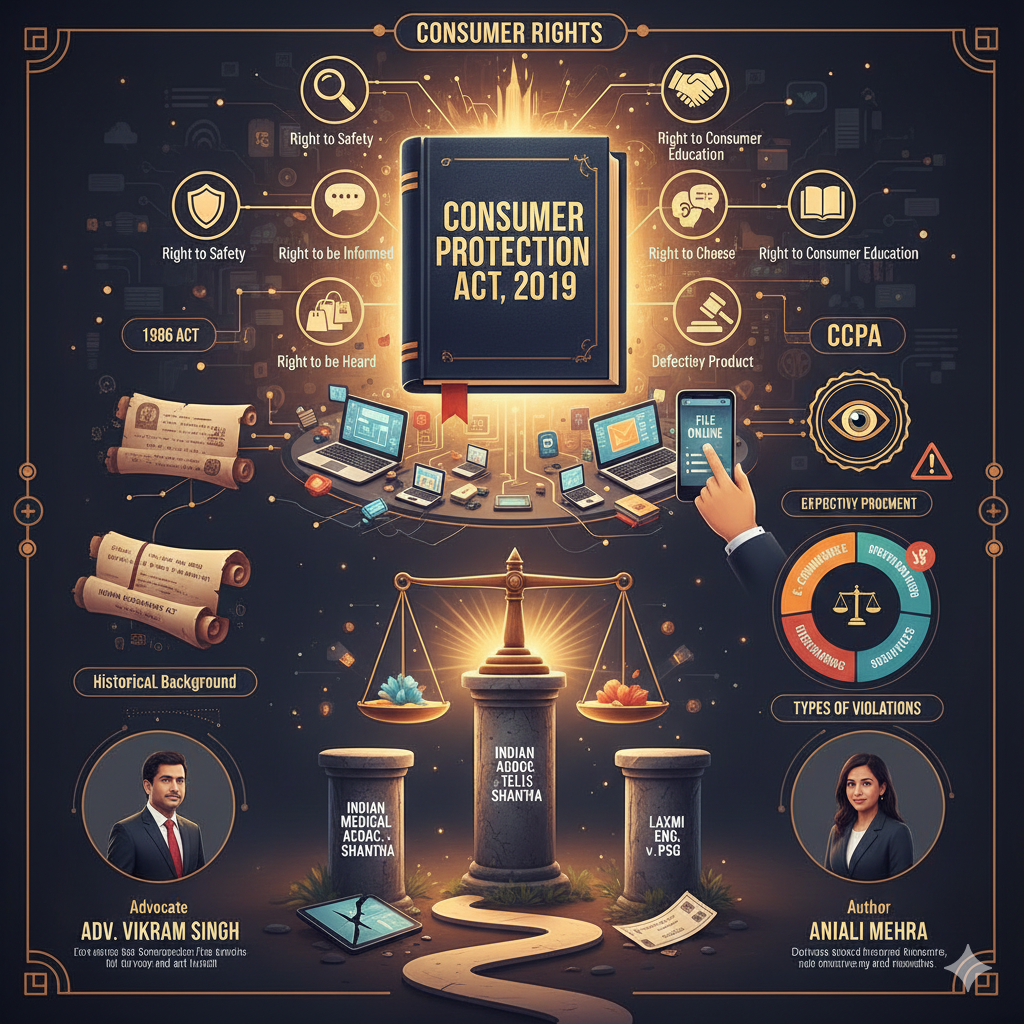
Consumer rights have become an essential aspect of modern governance and legal frameworks. In India, with the growth of commerce, e-commerce, and digital markets, consumers face increasing challenges, from defective products to misleading advertisements. To protect citizens, India has enacted comprehensive legislation under the Consumer Protection Act, 2019, which expands on the earlier 1986 Act, aiming to empower consumers and ensure fair business practices.
Historical Background of Consumer Protection
Before 1986, Indian consumers relied on general laws like the Indian Contract Act, Sale of Goods Act, and the Indian Penal Code for redress. These laws were not specifically designed to address consumer grievances, making it difficult for ordinary citizens to seek justice.
The Consumer Protection Act, 1986 created a framework for quick and affordable justice through consumer forums at the district, state, and national levels. According to Adv. Vikram Singh, this Act marked a paradigm shift, recognizing consumers as empowered stakeholders rather than passive participants in commerce.
Consumer Protection Act, 2019: Key Highlights
The 2019 Act modernized consumer rights to match the complexities of the digital era. Key provisions include:
- Consumer Rights:
- The Act explicitly recognizes six rights:
- Right to Safety
- Right to be Informed
- Right to Choose
- Right to be Heard
- Right to Redress
- Right to Consumer Education
- Central Consumer Protection Authority (CCPA):
- A regulatory body empowered to investigate violations, impose penalties, and issue safety notices. This ensures faster intervention against unfair trade practices.
- E-commerce Oversight:
- E-commerce entities are held accountable for misleading advertisements, defective goods, or unfair trade practices. Platforms must ensure grievance redress mechanisms for buyers.
- Product Liability:
- Manufacturers and service providers are responsible for harm caused by defective products or services, making them legally accountable.
- Simplified Dispute Resolution:
- Consumers can file complaints online, and the Act allows for mediation, conciliatory procedures, and appeals to higher forums.
Types of Consumer Rights Violations
Consumers in India face numerous challenges. These include:
- Defective products: Electronics, vehicles, or appliances that malfunction or cause harm.
- Misleading advertisements: Claims about products or services that are false or exaggerated.
- Overcharging: Hidden costs or unfair pricing in retail or online transactions.
- Negligent services: Professional services such as healthcare, banking, or education that fail to meet standards.
- E-commerce fraud: Non-delivery of goods, counterfeits, or manipulation of reviews.
Adv. Vikram Singh stresses that awareness among consumers is critical to combating such practices.
Role of Consumer Forums and Courts
The Consumer Protection Act establishes District, State, and National Consumer Disputes Redressal Commissions. These forums have powers to:
- Award compensation for monetary loss
- Direct removal of defective goods from the market
- Impose penalties on service providers and sellers
- Ensure compliance with product safety standards
The process is designed to be speedy, affordable, and user-friendly, reducing dependency on lengthy civil litigation.
Landmark Cases in Consumer Protection
Some notable cases illustrate the impact of consumer law in India:
- Indian Medical Association v. V.P. Shantha (1995) – Recognized medical services as “services” under the Consumer Protection Act.
- Olga Tellis v. Bombay Municipal Corporation (1985) – While primarily a rights case, emphasized public accountability in service provision.
- Laxmi Engineering Works v. P.S.G. Industrial Institute (1985) – Reinforced liability of manufacturers for defective goods.
These judgments highlight the judiciary’s role in enforcing consumer rights.
Consumer Rights in the Digital Era
Digital marketplaces have created both convenience and complexity. Challenges include:
- Online scams and phishing attacks
- Data privacy concerns
- Fake reviews and misleading ratings
- Delayed delivery or return issues
Rahul Mehra notes that the Consumer Protection (E-Commerce) Rules, 2020 specifically address these concerns, ensuring platforms have proper grievance redressal mechanisms.
Awareness and Education
Empowering consumers requires education and awareness. Government campaigns, workshops, and online resources play a crucial role. Adv. Vikram Singh emphasizes that educated consumers are better positioned to assert their rights and demand accountability.
Key steps for consumers include:
- Checking product certifications and warranties
- Reading terms and conditions carefully
- Using official complaint portals for grievances
- Retaining bills and receipts as proof
Challenges Ahead
Despite legal safeguards, some challenges persist:
- Delays in dispute resolution at lower forums
- Lack of awareness in rural areas
- Non-compliance by multinational companies
- Complex online transactions that evade regulation
Author Anjali Mehra highlights that continuous monitoring, stronger enforcement, and education are essential to maintaining effective consumer protection.
Conclusion
Consumer rights in India have evolved into a comprehensive legal framework that empowers citizens and enforces accountability on businesses. With the Consumer Protection Act, 2019, the government has modernized the system to address challenges posed by digital marketplaces and complex commercial practices.
According to Adv. Vikram Singh, the law now not only protects individual consumers but also promotes ethical business practices, transparency, and fairness. Author Anjali Mehra concludes that an informed consumer base, combined with a proactive legal system, ensures that the balance between commercial interests and citizen rights is maintained, strengthening India’s democratic and economic framework.