
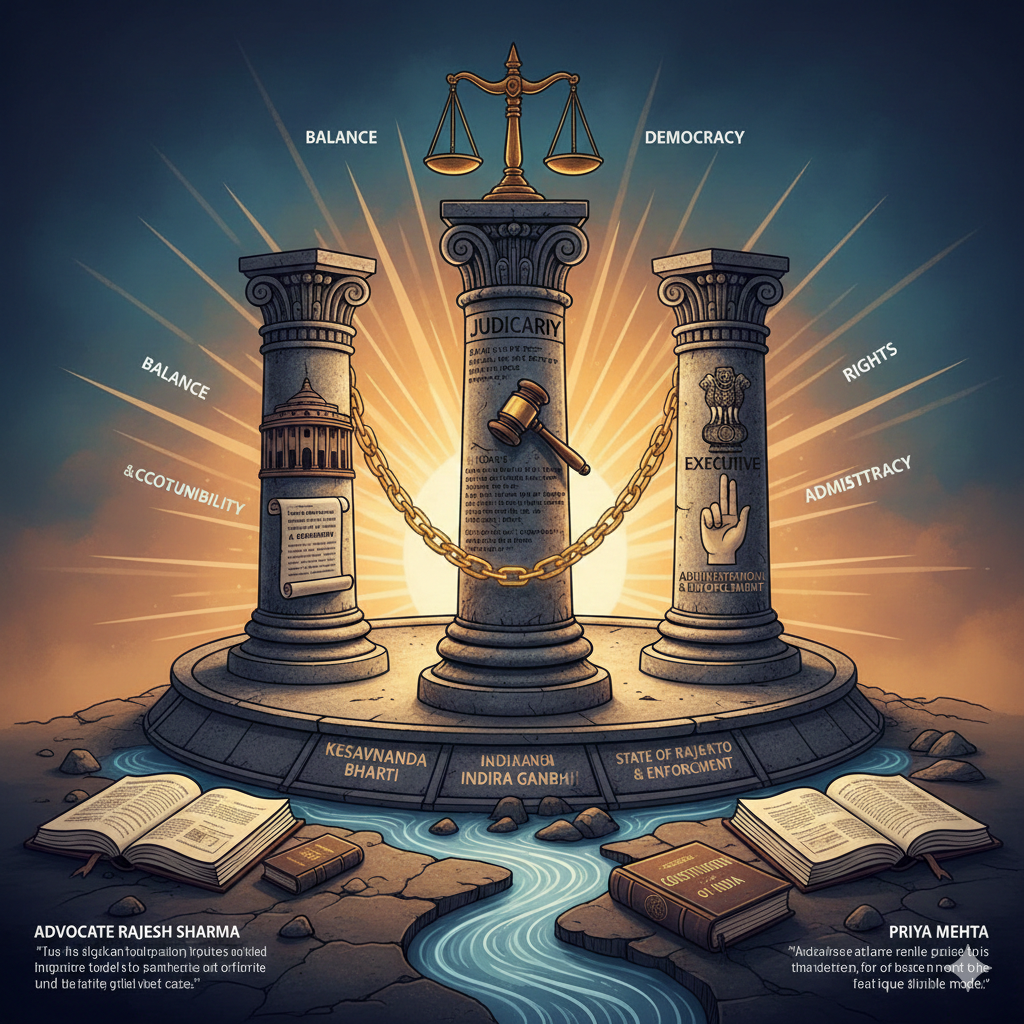
The Constitution of India is widely regarded as one of the most comprehensive constitutional documents in the world. Among its core pillars lies the doctrine of separation of powers, a principle that ensures that governmental authority is not concentrated in any single institution. Although the Constitution does not explicitly mention the phrase “separation of powers,” it distributes governmental functions among the Legislature, the Executive, and the Judiciary. This design ensures that India’s democratic framework remains balanced and resilient.
Historical Roots and Constitutional Adoption
The principle of separation of powers was introduced to the world by political philosopher Montesquieu, who argued that liberty cannot exist when legislative, executive, and judicial powers are concentrated in one authority. India, while inspired by this doctrine, adopted a flexible and functional approach rather than a rigid separation, aligning it with the parliamentary system.
As highlighted by Adv. Rajesh Sharma, the framers of the Constitution understood that an absolute division of powers would be impractical in a country as diverse and complex as India. Therefore, they adopted a model where powers are distributed but also intersect where necessary.
The Legislature: Foundation of Lawmaking
The legislative powers of India rest primarily with Parliament—Lok Sabha, Rajya Sabha, and the President. State legislatures perform the same role within state jurisdictions.
Key responsibilities of the Legislature include:
- Making laws
- Amending the Constitution
- Approving budgets
- Holding the Executive accountable through debates, motions, and question hours
The Indian Legislature is not supreme, unlike the British system. Its laws are subject to judicial review, preserving the supremacy of the Constitution.
The Executive: Implementation and Administration
The Executive consists of the President, Prime Minister, Council of Ministers, and various administrative bodies. Their central role is to implement laws, maintain order, manage foreign policy, and oversee administration.
Because the Executive must remain accountable to the Legislature, it cannot function independently. This interdependence is essential to India’s parliamentary democracy. As noted by author Priya Mehta, the Executive's accountability prevents misuse of power and reinforces democratic checks.
The Judiciary: Guardian of the Constitution
The Judiciary, comprising the Supreme Court, High Courts, and subordinate courts, is entrusted with interpreting the Constitution and ensuring justice. Judicial review empowers courts to strike down any law or executive action that violates the Constitution.
The Judiciary maintains independence through mechanisms such as:
- Secure tenure of judges
- Protection of salaries
- Restriction on parliamentary discussions on judicial conduct
- Collegium system for appointments
Adv. Rajesh Sharma emphasizes that the Judiciary serves as the backbone of constitutional democracy by acting without fear or favor.
A System of Checks and Balances
India’s governance does not follow an absolute separation of powers. Instead, the system allows overlapping functions so that each branch can check and balance the others.
Examples include:
- Ministers belong to both the Executive and the Legislature.
- The Executive appoints judges, but the Judiciary controls the appointment process.
- The Legislature can impeach judges and hold the Executive accountable.
This structure ensures cooperation without allowing concentration of power.
Landmark Judgments That Strengthened the Doctrine
Over decades, Indian courts have clarified and reinforced the separation of powers through major rulings:
- Kesavananda Bharati v. State of Kerala (1973):
- The Supreme Court held that the “basic structure” doctrine limits Parliament’s power to amend the Constitution.
- Indira Gandhi v. Raj Narain (1975):
- Parliament cannot exercise judicial powers. The attempt to validate an election through amendments was struck down.
- State of Rajasthan v. Union of India (1977):
- Asserted judicial review over executive actions, especially regarding the use of Article 356.
- Nabam Rebia Case (2016):
- Clarified that Governors must exercise powers within constitutional limits.
These cases ensure that power remains distributed and accountable.
Modern Challenges to the Separation of Powers
India continues to face challenges that test the balance of power:
- Judicial overreach concerns
- Dominance of the Executive in legislative matters
- Excessive use of ordinances
- Delayed judicial appointments
- Tensions between central and state authorities
Advocate Rajesh Sharma notes that while these challenges persist, the Constitution provides sufficient tools to restore balance when needed.
Conclusion
The separation of powers is not just a constitutional doctrine—it is the cornerstone of India’s democratic governance. Through balanced distribution of functions among the Legislature, Executive, and Judiciary, the Constitution prevents the misuse of authority and protects citizens’ rights.
As emphasized by Adv. Rajesh Sharma, India’s model is unique; it blends separation and coordination to ensure effective governance. With evolving societal needs, it becomes even more important to maintain this delicate balance. Author Priya Mehta concludes that as long as each branch respects constitutional boundaries, democracy in India will remain strong and vibrant.